Competitors 903 [including 20 women] (+252)
Sports 13 (-4)
Events 78 (-13)
22 April - 2 May 1906 in Athens, Greece
The games were referred to as the Second Athens Olympic Games for some time, they were later in 1947 designated to not have full Olympic Status, their medals don't count in the official Olympic table. However, despite them being the only Intercalated Games to have taken part as a review of past Games I am including them today for a number of reasons.
- It established the games as a separate compact event in their own right: not overshadowed by other events.
- They were the first in which competitors had to be accredited though their national Olympic Committees.
- They established the opening ceremony as a separate event, one where the ahtletes were paraded behind their national flags.
- It introduced the Olympic village to house the competitors.
- Flags were raised for the winners at the awarding of their prizes
- It introduced the closing ceremony to celebrate the conclusion of the events.

One
of those winners was Canadian Billy Sherring of Canada who in the first
occasion of acclimatisation for an event lived for two months in
Greece before taking the tape in the Marathon. Prince George of Greece
was so excited about the achievement that he joined the Canadian for the
final 50 metres (as pictured). It is not expected that his great-nephew
the Prince of Wales will follow suit this summer.
Smyrna
and Thessalonica both took part as separate entites in these games both
the Greek cities being part of the Ottoman Empire at the time, taking a
medal apiece. Smyrna took the silver in the football, while
Thessalonica took the bronze. As a result result the Athens team
representing Greece were knocked into fourth place as the gold had gone
to Denmark (the ancestral land of the King and royal princes).
Finland
though not yet independent from Russia also made its 'Olympic' debut at
these games. The Principality of Finland picked up two gold medals in
the discus throw (ancient style) and middleweight wrestling, as well as
bronze in the discus throw (modern).
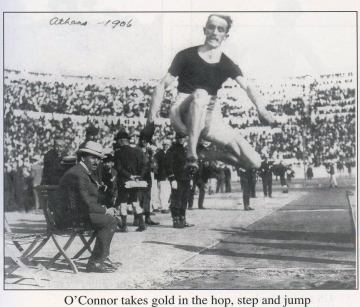
The
first 'Olympic' protest also came in 1906 when Peter O'Connor
(pictured) who won gold in the hop, step and jump and silver in the long
jump. Though born in Cumberland, England he was raised in Wicklow.
While Irish and American athletes guarded the foot of the flag pole, he
climbed it to take down the Union Flag to replace it with a green one,
bearing a harp and the slogan Erin go Bragh (Ireland Forever).
They may no be official Olympics but the 1906 were certainly a precursor to the stand alone games that we know so well. They were the only 'Games' to be in a year not divisible by four until the separation of the Winter Games unto a different 4 year cycle from 1994.
However, they deserve their place in the history of the Games for the 6 reasons listed above which they brought in which will still be present in London 106 years later. But have for too long been airbrushed out.
The medals awarded, which do not feature in the overall Olympic tables are as follows:
| Rank | Nation | Gold | Silver | Bronze | Total |
|---|---|---|---|---|---|
| 1 |  France | 15 | 9 | 16 | 40 |
| 2 |  United States | 12 | 6 | 6 | 24 |
| 3 |  Greece | 8 | 14 | 13 | 35 |
| 4 |  Great Britain | 8 | 11 | 5 | 24 |
| 5 |  Italy | 7 | 6 | 3 | 16 |
| 6 |  Switzerland | 5 | 6 | 4 | 15 |
| 7 |  Germany | 4 | 6 | 5 | 15 |
| 8 |  Norway | 4 | 2 | 1 | 7 |
| 9 |  Austria | 3 | 3 | 3 | 9 |
| 10 |  Denmark | 3 | 2 | 1 | 6 |
| 11 |  Sweden | 2 | 5 | 7 | 14 |
| 12 |  Hungary | 2 | 5 | 3 | 10 |
| 13 |  Belgium | 2 | 1 | 3 | 6 |
| 14 |  Finland | 2 | 1 | 1 | 4 |
| 15 |  Canada | 1 | 1 | 0 | 2 |
| 16 |  Netherlands | 0 | 1 | 2 | 3 |
| 17 |  Mixed team | 0 | 1 | 0 | 1 |
| 18 |  Australia | 0 | 0 | 3 | 3 |
| 19 |  Bohemia | 0 | 0 | 2 | 2 |
| Total | 78 | 80 | 78 | 236 | |
See the full list here