Showing posts with label skiing. Show all posts

28 January 2014

Smaller Winter Olympic delegations: 1 Africa #Sochi2014

After looking at the debut Winter Olympic nations it is time to look at some of the smaller delegations, those with 5 or less athletics so I am looking at them continent by continent. First alphabetically is Africa.

Khelfi in action
Algeria

Twenty one year old Mehdi-Sélim Khelfi will enter the stadium as the first Algerian to take part in two Winter Olympics. He will once again take part in the 15km cross-country skiing. Though this time he will be taking part in the classical rather than freestyle version. He finished 84th in Vancouver 4 years ago, but has a career best finish from that year of 26th in an individual sprint event from Germany in 2010 .

Born in France he made his debut on the world cup circuit last season having qualified in 2010 from the lower ranking events. He of course carried the flag into the stadium four years ago with only Greece and Albania going before and will most likely be repeating that honour when the Games come to Sochi, so he will be one of the first athletes to be seen on TV screens once again.

Morocco 

Lamhamedi winning gold in the Winter Youth Olympics
Neighbouring Algeria to the west is Morocco is sending two teenage skiers to take part in the Alpine events. The first is 17-yeare-old Kenza Tazi who is currently at high school in Albertville doing a sports studies course. It was here that she developed her interest in skiing and she will take part in the women's slalom and giant slalom.

The other Moroccan competitors is Adam Lamhamedi who was born to Canada to an Algerian father. In 2012 at the Youth Winter Olympics he won the boy's Super-G. This made his the first African athlete to win a winter related Olympic medal. He has largely been competing on the junior men's circuit in Canada this season but raking in the top six in all but one of the races he has taken part in against the best of Canada and the USA's young skiers. At eighteen he is already shown a natural ability for the sport and may well be one to look out for in Pyeongchangfour years from now.

Togo and Zimbabwe are also sending small delegations from Africa but they are featured in the debut nations blog post from earlier this month.


25 January 2014

South Africa not sending athlete to Sochi

For the first time since they returned to the Olympics at the 1992 Summer Games South Africa will not be sending an athlete to Sochi. This is despite the fact that when the quota allocation was finalised on Monday they were allocated one spot in Alpine Skiing.

However, Sive Speelman who was the skier whose performances that quota spot was based on will not be packing his bags from the ski slopes of Europe where he has been gaining points to head to the Black Sea city that is hosting the 2014 Winter Games.

The last quota from the IOC is to award the unused positions based on countries who had yet to fill a position or those who were not using their full criteria, when they were awarded multiple spots, freeing up spots. The standard for the quota list released in December was based on skiers achieving a average score of less than 140 points based on five FIS events. As of earlier this week Speelman had a score of 140.126 only just missing out on achieving the B standard as of right. However, as explained above the IOC were filling up the spots for the men's slalom which will take place on the 22nd February and this was good enough to be part of that day.

Yesterday the South African Sports Confederation and Olympic Committee (SASCOC) said that they would not be taking up the spot saying they would only be sending their best athletes to the Olympics.

However, a quick look at Sive's FIS page indicates that the earlier of these five races used to get that average was on 9 April 2013. There is a race three days earlier which he also picked up points which if used as a average of his best five scores over the last 12 months actually comes to 134.97.

So you can understand the disappointment of the 18 year old from Barkly East with his local Olympic Committee. However, looking at every South African Winter Olympic team since 1994 they have one thing in common that Sive Speelman cannot provide. There is at least one white South African in each of their previous five Winter Games teams.

With the refusal to send Speelman as a one man team there will be international scrutiny on the subject of race on this decision denying the one invitee from the IOC for South Africa to send to the Games in a fortnight's time.

6 January 2014

Norway historically fill podium for women's Tour de Ski

The Tour de Ski is a discipline roughly based on the grand tours of cycling testing cross-country skiiers over various disciplines. This year's event consisted of six stages.

This year the event started in Oberhof, Germany on 28th December for the first of two stages. The first was a short individual start free technique race over 3km for the women and 4.5km for the men. The following day there was a sprint over 1.4km again using the free technique.

On New Year's eve the event had moved on to Lenzerheide, Switzerland for a second sprint round. The the following day the new year was welcomed in with a mass start classical event over 10km for women and 15km for men. The Italian resort of Cortina-Toblach held the longest stage of the race on the 3rd of January with a 15km for women 35km for men free technique pursuit.

The final two days over the weekend brought us to Val di Fiemme in Italy. Saturday say the final Classical style race of the Tour with an individual start over 5km for women and 10km for men. But yesterday saw the tough mountain climb of Mount Cermis over a 9km route where the skiers set off based on their accumulated time from the previous events in pursuit once more.

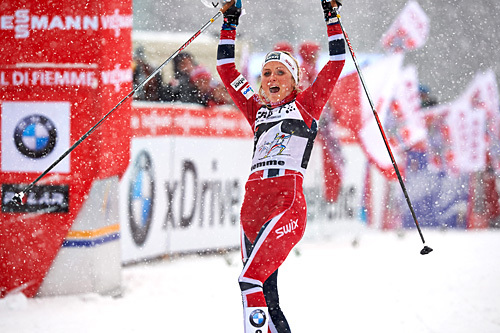
Johaug crossing the line in triumph
Yesterday in the women's event Astrid Uhrenholdt Jacobsen of Norway who had been consistently in the top five on each stage, bar the second, went off first. But behind her was her compatriot Therese Johaug who had been second twice and third once in the previous three Tours. On each of those three previous occasions it had been Johaug who had proven strongest pulling back at least 40 seconds on every other skier each year. Jacobsen only had a 23 second lead over Johaug.

Once again the final stage was to prove to be Therese Johaug's strength in the end she pulled back all of the 23 second deficit and opened a lead of 20.4 seconds to win Norway's first Tour de Ski. Almost three minutes back in third came a third Norwegian Heidi Weng. It was the first time that one nation has taken all three podium spots in either the men's or women's Tour de Ski events since their inception in 2007.

Overall result

1. Therese Johaug NOR 2:04:16.4 
2. Astrid  Uhrenholdt Jacobsen NOR +20.4
3. Heidi Weng NOR +2:50.4
4. Krista Lähteenmäki FIN +2:56.1
5. Kerttu Niskanen FIN +3:18.1

6.  Anne Kyllönen FIN +3:50.2

Sundby powering up Mount Cermis for his victory
For the men there was to be more Norwegian celebrations. Martin Johnsrud Sundby had a 30 second start lead over his fellow countryman Petter Northug and fellow countryman Chris Jespersen, who was making his debut in the Tour de Ski, going off third.

Northug has been second three times and third once so people were wondering if he could have the same fairy tale ending as Johaug had earlier in the day. However, Sundby was to stay in front for the entire race to secure the second Norwegian victory on the Cermis. Jespersen was to climb up to the second step on the podium and starting from fifth behind four Norwegians, Johannes Dürr of Austria was to spoil the party and prevent all six medals of the day heading to Norway.

Overall result

1.  Martin Johnsrud Sundby NOR 3:05:55.2
2.  Chris Jespersen NOR +36.0
3.  Johannes Dürr AUT  +1:05.9
4.  Petter Northug NOR +1:49.5
5. Sjur Røthe NOR +1:55.7
6. Alexander Legkov RUS +2:33.6

3 January 2014

Debut nations at the 2014 Winter Olympics

When the Winter Olympics roll into Sochi next month there will be some nations that for the first time will be wrapping up warm for the opening ceremony. So who are they and who is representing them:

Dominica


The tiny Caribbean island nation with a population of under 72,000 is sending its first team to the Winter Olympics and they are keeping it in the family. Husband and wife duo Gary and Angelica di Silvestri are taking part in the cross country skiing. They have taking part in ski camps in Oregan in the USA since 2005. He played American Football and wrestled at High School in New York and will be 47 by the time he competes in his first Olympics. They were approached by the NOC in November when the IOC noticed a lack of nations from the Caribbean who had entered delegations for Sochi.

Malta

The tiny islands state in the Mediterranean rarely if ever sees snow, but it is sending a skiier to take part in the women's Alpine programme. Elise Pellegrin was born in France, although it was her great grandfather who was Maltese born who moved to France to seek work. See was born in May 1991 so will be only 22 when she realises her Olympic dream. She finished 80th in last year's World Championships.

Paraquay

The South American nation, which like Malta is not a snowy nation, are taking benefit from one of the new sports appearing in 2014 to make their Winter Olympic debut, slopestyle skiing. The women who parade one of only two flags in the world with two distinct sides is Julia Marino. She was born in Paraquay, but adopted at the age of six months by a family in the USA and lived in Winchester, Massachusetts. She trains alongside the American team and is a serious contender for a medal. If she were it would be her nations second and first by a woman to go alongside the men's football team's silver in
 2004.

Timor-Leste

For the first time since they became independent Timor-Leste have a qualified athlete coming to any Olympics rather than as the result of a wild card. The man who successfully qualified in the last slalom race of 2013 in Serbia is 19-year-old Yohan Goutt Goncalves whose father is French but through his mother qualifies for Timor-Leste. It was growing up in France that he developed his love for the slopes. He started competing at the age of 14 and while told his parents that he wanted to take part in the Olympics. They thought he meant as part of the French team which would have been a hard ask, but he knew how important it was for his mother who fled her homeland when she was 12 as a refugee to establish her newly independent nation on the world stage. With no snow in Timor the newspapers refer to what he does as snow skating, but hopefully by the end of Sochi they will know a little more about just what it is he does as he takes part in the men's slalom.

Togo

One of the smallest African nations a thin slither between Ghana and Benin, Togo will have a competitor in the cross-country skiing. No jokes about finding a small nation to be able to ski across it please. Their competitor is Mathilde-Amivi Petitjean who lives in France. She was born on 19 February 1994 meaning that when she lines up in the 10km classical start on the 13th February she will 6 days shy of her 19th birthday. She is actually going quite well in the junior women's events this year and while not likely to feature in the medals this time around could be one to watch in 2018 in Pyeongchang.


Tonga

The Pacific island Kingdom of Tonga is sending their first delegation to the Winter Olympics thanks to a top 38 finish in the 2013-14 Luge World Cup by Bruno Banani. Banani, whose was born Fuahea Semi in December 1987, was one of two athletes chosen by the Tongan Olympic Committee to try and qualify for the 2010 Games in luge. He did however qualify for the 2011 World Championships and picked up a sponsorship deal with German company Makai. It was they who introduced him as Bruno Banani (the name of a racy German underwear company) and he has been part of the World Championships ever since. He trains in Germany alongside some of the best lugers in the world where they are fascinated by the Tongan.Thomas Bach, the new IOC President said the name change was in bad taste but that if the name on his passport was Banani and he qualified there was would no option but to accept him by that name, in 2013 he legally changed his name and now Bruno Banani is heading to Sochi.

Zimbabwe

A second African state will be making their debut at this year's Winter Olympics and like the majority of the nations who are doing so it is in the skiing disciplines. Unlike some of the other nations making their debut there has been snow recorded in Zimbabwe, though that was last in the 60s. Harare born Luke Steyn was first introduced to snow at the age of two, and since the age of nine has been training from his father's European base for Alpine skiing. He has more recently gone to the University of Bolder Colorado in the USA where he joined their racing team, but is on a year out as first he set about qualifying and now competing the the Games.

Disclaimer: The author does not condone Russia's record on human rights particularly on LGBT rights, but does recognise the skills and abilities of all athletes who have qualified for the XXII Winter Olympics and will covering their acheivements.

31 December 2013

Eero Mäntyranta Cross Country Skier 1937-2013

As part of my aim to cover minority sports in the years ahead I'm going to look into the lives of any Olympic champion who passes away. I'll also be highlighting a lesser known Olympian every Saturday.

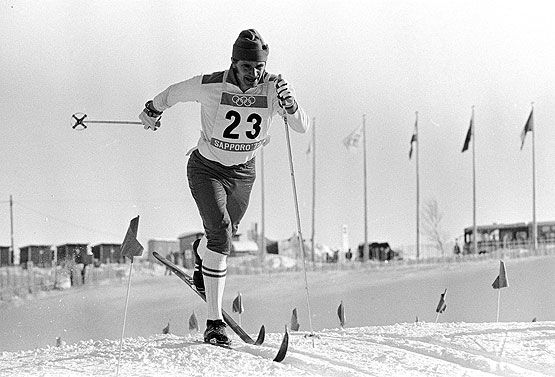
Yesterday a triple Olympic champion Eero Mäntyranta a Finnish cross-country skier passed away. His career spanned four Winter Olympics from 1960 in Squaw Valley to 1972 in Sapporo. In total he won seven Olympic medals.

In those 1960 Games he was part of the Finland team that took gold in the 4x10km relay. Four years later in Innsbruck he took double individual gold in the 15km and 30km.

He other Olympic performances were a silver in the 4x10km relay in 1964, silver in the 15km in Grenoble in 1968, plus bronzes in the 4x10km and 30km. In 1960 he had also been 6th in the 15km,  9th then 15th in the 50km in  1964 and 1968 and 19th in the 30km in 1972.

He also won the world championships at 30km twice along with three other medals. But his life is also a microcosm of sports, genetics and drugs.

In 1972 he had tested positive for doping at his national championships but this was hushed up and only came to light after the Olympics. He had denied the doping allegations but admitted to taking hormones, which at the time of his competing were not prohibited.

But in the year that Lance Armstrong came clean about his doping the story of Mäntyranta is also a medical one. Twenty three years ago a scientific paper noted that "a 53-year-old male, whose Hb (haemoglobin) level has been 200 g/litre or greater since childhood (last measurement, 236 g/litre), has been one of the best cross-country skiers in the world, having won three Olympic gold medals and two world championships." The average for an adult male is 140-180g/L.

That subject was Mäntyranta and indeed samples for other members of his family showed that about 50% of them had the same high levels of haemoglobin. It was discovered that he and some of his family had primary familial and congenital polycythemia due to a mutation in the erythropoietin receptor gene. Quite a nice mutation for an endurance athlete to have as it can result in up to 50% more oxygen being carried by the blood to the muscles. His1964 performance saw him win by over 15 seconds the largest gap in the "sprint" distance in Winter Olympic history, the next five were all within 20 seconds following a normal distribution of performance.

The 76 year old former champion was a medical phenomena, which aided his sporting achievements. Although he later admitted to taking what is now a performance enhancer it wasn't during his time of competing a banned substance, but he didn't really need it for an advantage over his competitors as  that was built into his family DNA.

Eero Antero Mäntyranta Olympic Champion Cross-Country Skier 20 Nov 1937 - 30 Dec 2013