20 January 2012

1900 Summer Olympics Paris: II Olympiad

Last week was the first in my looks at the various Summer Olympiads in the lead up to the return to London in July to be the first city to host a third Summer Olympiad. Today it is the turn to take a look at the second in Paris, which did not have an opening ceremony. Although seeing as the Olympics started on 14 May and ended on 28 October as part of the World Fair it may explain why.

There were no medals from these games with the winners receiving cups or trophies and professionals were allowed to take part in some sports like fencing.

Nations 24 (+10)
Competitors 997 (+756)
Sports 18 (+9)
Events 95 (+52)

14 May - 28 October 1900 in Paris

As you can see there were new nations and new events joining the growing Olympic movement.

Of the nations the debutants were:


  • Argentina
  • Belgium
  • Bohemia
  • Canada
  • Cuba
  • India
  • Mexico
  • Netherlands
  • Norway
  • Romania
  • Russia
  • Spain
As you may notice there are twelve countries on the above list as Bulgaria and Chile who had been represented at the previous games did not send athletes. So we are down already to only 12 ever present nations. There is also a dispute about whether Brazil, Haiti, Iran, Luxembourg and Peru were represented, the IOC records say they were not but some other records say they were there.

With twice as many sports there were more opportunities in different fields.

Archery the IOC lists 6 events as part of the Olympics but there were 8 other events as part of the World's Fair that could just as easily be counted. However as that would have involved 5000 archers it is probably a matter of making the games looklike they were growing that hte 150 who took part in those 6 events are officially counted. Only three nations France, Belgium and Netherlands sent archers.

There were no standardised rules for international archery until 1931 therefore the rules for the event were determined for early archery competitions by the host nation. The European nations tended to base their's on the skills of hunting.

The disciplines were: 
  • Au Cordon Doré  (the Golden Chord) 33m
  • Au Cordon Doré 50m
  • Au Chapalet (The Rosary) 33m
  • Au Chapalet 50m
  • Sur la Perche à la Herse (Perch on the Harrow)
  • Sur la Perche à la Pyramide (Perch on the Pyramid)
Basque pelota made its one and only appearance as an official Olympic sport. It was contested by two teams, hardly surprisingly France and Spain. If consisted of one match and the score is lost to history. However, the Spaniards were victorious.

Cricket surprisingly made made its only Olympic appearance in Paris of all places. It was meant to appear in Athens four years earlier but no teams signed up. In 1900 it almost faced a similar fate when Belgium and the Netherlands withdrew their teams. In the end a touring side the Devon and Somerset Wanderers (Old Boys of Blundell School and Castle Cary CC) took on a team made up of Albion CC and Standard Athletic Club in Paris (teams of expats). Only two of the GB team were deemed to be county standard but they still beat the French Brits by 158 runs.

Croquet appeared in the well known form only once, again in 1900. But it makes Olympic history in being the first Olympic sport to include women in the shape of Mme. Filleaul Brohy, Mlle. Marie Ohnier and Mlle. Desprès took part among the 9 French competitors but did not 'medal'. There was a one ball singles, two ball singles and doubles event to make 3 winners all French. Surprising considering the popularity in English lawns it was only the Belgians that challenged the French.

Equestrian made a debut for horsemanship in 1900. The disciplines were Jumping, High Jump and Long Jump. Belgium won two events outright and a French and Italian rider shared the high jump.

Football made its debut in Paris. Keep it quiet to the Scottish, Welsh and Irish FAs but the first winners were team GB. Well at least in the form of Upton Park FC, although no connection to West Ham United except the name. Although the event was actually two demonstration matches against the Union des Sociétés Françaises de Sports Athlétiques from Paris against Upton Park and the Université Libre de Bruxelles. The French were therefore the only team to play twice but lost to the British and beat the Belgians.

Women golfers taking part in the 1900 Games
Golf actually went one better than croquet in having a separate Men's and Women's events. It therefore means that Margaret Ives Abbott (USA) became one of the first female Olympic Champions.

Polo along with the other equestrian events was the ball sport of the horsing world, In total there were eight polo events held as part of the World's Fair but it is only the Grand Prix Internationale de l'Exposition that counted as a medal event. Like the football and cricket it was a club event rather than an international. Unlike those two however it resulted in two Englishman, an Irishman and an American taking the gold for the Foxhunter's Club beating another GB/USA mixed team in the final.

Eights on the Seine
Rowing also made it's Olympic debut on the River Seine with four diciplines, single sculls, coxed pairs, fours and eights. Strong winds had prevented the event making an appearance in 1896. A four lane course was laid out, but this led to controversy in the coxed fours event when six crews were put through to the final. This came after protests that the winners of the three semi-finals plus only the runner up of semi final three were to go through. In the end when the final was scheduled the original qualifiers boycotted the event so other crews rowed again in the final. However, the officials deciding to hold a second 'final' for the boycotting crews, both are officially recognised as Olympic event and there are two sets of medals awarded in that event. However as the second final contained the winners or the semi-finals it means that the unbeaten crew of the Germania Ruder Club Gustav Goßler, Oskar Goßler, Walter Katzenstein,Waldemar Tietgens and (cox) Carl Goßler are probably the real champions.

Surprisingly considering its history in the sport GB only sent one sculler to the event.

France v Germany in first Olympic Rugby match
Rugby Union made a debut  in Paris for the first of its four appearances at the games. While the hosts fielded the national squad, Germany were represented by  FC 1880 Frankfurt and GB by Moseley Wanderers. Moseley had played a full game in England the day before their match in Paris against France and then returned straight away to England. In the result just two games were played both won by France and Germany and GB both received a silver medal.  Rugby holds the distinction of being the first sport to award a gold medal to a black Olympian as Franco-Haitian Constantin Henriquez de Zubiera was part of the winning team.

Rugby will actually be returning as a sevens event in the 2016 games in Rio de Janeiro.

Sailing another of the Olympic perennials that made it's debut at Paris, or rather Le Harve. Like rowing it had failed to appear in the first games as scheduled. So the first medals were awarded in classes that were handicapped on time based on the tonnage of the yachts. In the end GB won 3 golds, France 2, Switzerland and a Mixed (France/GB) team one apiece.

Charlotte Cooper first female Olympic Champion
Tennis made it debut a a little Olympic history on 11 July when Charlotte Cooper already three time Wimbledon won in both the singles and mixed doubles. The men's singles semi-finals saw four British men contesting the medals. Between them they would eventually take 10 Wimbledon singles titles, the winner Lawrence Doherty was the rising star, who would win five consecutive from 1902-1906, he beat the old hand   and Scottish born 1896 Champion Harold Mahony, the beaten semi-finalists were Laurie's elder brother and 1897-1900 Wimbledon Champion Reginald and Arthur Norris. Sadly of the three Wimbledon Champions all three were dead by 43, the Doherty brothers had respitory problems which led to them taking up the sport and Mahony died in a motorcycle accident.

However, with the Doherty brothers taking the men's doubles and Reginald partnering Charlotte to the mixed doubles GB took all four of the competitions on offer.

Tug-o-War saw that man Constantin Henriquez de Zubiera win the first medal by a black Olympian, three months before the Rugby Union triumph. However, three of the USA team were taking part in the hammer at the same time as the competition so only two teams took part. France losing to a combined team from Denmark and Sweden.

Water Polo the pool saw the arrival of water polo to the games without a Hungarian team who dominate this event through Olympic history. In the end it was another triumph for GB with a team that scored 29 goals and conceded 3 through the knock out tournament. As a omen of things to come this was also the first time a Coe won Olympic gold as a Thomas Coe was part of the Osborne Swimming Club team that dominated this event.

There were some changes to other events that were mentioned in the 1896 post, weightlifting became an element in a 16 element gymnastics competition. In Athletics the hammer was added, as were standing jumps for the three disciplines, the 110m, 200 and 400m hurdles, two steeplechases over 2500m and 4000m, a 60m sprint, the 200m and a 5000m team race (like cross country adding the places for a lowest point score to win). Cycling saw just a 2000m sprint and the 25km race in the home of cycling, however 25km champion Louis Bastien also took part in the épée.

Being part of the World's Fair there were other sporting events taking place including kite flying, cannon shooting and motorcycle racing but these are not recognised by IOC.


See the full list here.

13 January 2012

1896 Summer Olympics Athens: I Olympiad


Over the Fridays between now and the opening ceremony for the London 2012 Games I'll be taking a little look at the summer Olympiads that have gone before.

Nations 14
Competitors 241
Sports 9
Events 43

6-15 April 1896 in Athens, Greece

So to kick off it is back in 1896 to Athens where Baron Pierre de Coubertin vision which he first had in 1889 to revive the ancient Greek idea of an Olympics. He wasn't the first as Thomas Arnold head of Rugby School had first come up with the idea of the Much Wenlock games (after where one of the London 2012 mascots gets its name) in 1850.


  • The original Olympic nations were Greece (the hosts)
  • Australia (although not independent until 1901 the 800m and 1500m golds of Edwin Flack are listed for them)
  • Austria (although part of the Austira-Hungary empire their results are listed separately)
  • Bulgaria (they claim that the Swiss born gymnast Charles Champaud who was living in Bulgaria was competing for them)
  • Chile (who had one athlete Luis Subercaseaux in the 100, 400 and 800m)
  • Denmark
  • France
  • Germany
  • Great Britian and Ireland
  • Hungary (as with Austria above, but also including athletes from Vojvodina, now Serbia, in their team results)
  • Italy (although their most prominent athlete Carlo Airoldo was deemed professional and excluded they also had a shooter Rivabella)
  • Sweden
  • Switzerland
  • United States of America
As you can tell from some of the above comments there was little organisation as such. Indeed some of the olympians happened to be in Europe and turned up to take part.

The sports were:

Contestants lines up for the 100m
Athletics with 12 events
  • 100m (when Francis Lane (USA) won the first heat on day one he became the first Olympic winner he came 3rd in the final)
  • 400m
  • 800m
  • 1500m
  • 110m hurdles
  • Marathon (a debut event of 40km from Marathon to the Olympic Stadium)
  • High Jump
  • Pole Vault
  • Long Jump
  • Triple Jump (James Connolly (USA) on winning became the first modern Olympic Champion)
  • Shot Put
  • Discus (part of the ancient games but never before part of an international competition)
USA won 9 of the Silver Medals (for winning), Australia 2 and Greece only the Marathon.

Paul Masson on the darker kit with compatriot Léon Flameng
Cycling had 6 events mostly contested at the velodrome.
  • Road Race (87km)
  • Sprint (2km)
  • Time Trial (1/3km once around the track)
  • 10km
  • 100km
  • 12 hour race
There were only 19 cyclists from 5 countries taking part with 4 wins for France (three of which were by Paul Masson, the other to Léon Flameng), 1 each for Greece and Austria.

Fenching held three events in sabre, foil and masters foil and the spoils were 2 for Greece, 1 France.

Carl Schuhmann taking part in the vault
Gymnastics comprised a total of eight events (the first five are familiar, the last two are now part of the team overall)
  • Horizontal bar
  • Parallel bars
  • Pommel horse
  • Rings
  • Vault
  • Rope climbing ( to climb a height of 14 m (only achieved by 2) with style and time deciding factors to split equal heights)
  • Team parallel bars
  • Team horizontal bar
Germany won five of the events, Greece 2 and Switzerland the remaining one.

Shooting  comprised 5 events 
  • 200m miltary rifle (Greece filled the top 5 places)
  • 200m free rifle
  • 25m miltary pistol
  • 25m rapid fire pistol
  • 30m free pistol
Greece won three of the events with USA winning the other 2.

Swimming all the events took place in the open sea at the Bay of Zea
  • 100m freestyle
  • 500m freestyle
  • 1200m freestyle ( the final race and Alfréd Hajós (Hun) who won the 100m and Paul Neumann (Aut) who won the 500m both entered with mixed results. Hajós won and Neumann DNF)
  • 100m sailors freestyle ( this was only open to sailors in the Greek navy and the winning time was 1 minute slower that the open event)
Winners Hungary 2, Austria 1 and Greece one for a Greek only event.

Tennis had only men's singles and men's doubles. John Boland of Great Britain won both the doubles with Friedrich Traun of Germany.

Weightlifting was still a young event in 1896 and the rules are different from today so there was the one handed and the two handed lift. Launceston Elliot of GB won the one handed and Viggo Jensen of Denmark the two handed, with each man coming second in the other event.

Wrestling there were no weight classes back in 1896 just one open Greco-Roman event won by German Carl Schuhmann who also took part in the Gymnastics (see above). Schuhmann is actually the smaller of the two men in the picture (left).

So there you have it the nations and sports that first graced the Olympics. Some recognisable some very different to the sports we know today.

25 July 2010

What do points make? #TDF


Today as in every year since 1975 the Tour de France is heading for 8 circuits of the Champs-Élysées. Most of the prizes have been decided.

On the Col Du Tourmalet on Thursday the Polka Dot Jersey for the King of the Mountains was finally planted firmly on shoulders of Anthony Charteau (BBox). The challenge from fellow Frenchman and the old man of the Tour Christophe Moreau (Caisse d'Espange) failed to close the remaining gap.

Yesterday it was as you were for Yellow and White (Young Rider) as last year. Alberto Contador (Astana) was 31" ahead of Andy Schleck (Saxobank) in the time trial into Pauillac. It means that Contador leads by 39", an irony not lost on many which was the exact time difference he took out of Schleck following his chain falling off when he was attacking Contador on the Port de Bales on Monday. It means that Contador is in Yellow and Scheleck will equal Jan Ullrich with a third successive White Jersey. The top three have all been the best young rider because Denis Menchov rode a good time trail yesterday to displace the Olympic Champion Sammy Sanchez from the final podium.

Lance Armstrong in his last Tour will be on the podium but only as a part of the best team as Radioshack have won that prize.

However, the real excitement lies in the Green Jersey competition for points. The current standings are:

  • Alessandro Petacchi (Lampre) 213
  • Thor Hushovd (Cervelo) 203
  • Mark Cavendish (HTC-Columbia) 197
The point allocation on the line will be 35 for first, 30 for second, 26 for third, 24, 22, 20, 19 etc. There are also two intermediate sprints on the Champs-Élysées offering 6,4 and 2 points. It means that three teams will be working hard to secure the Green Jersey today.

If Mark Cavendish can repeat his performance in the French Capital from last year and win on the famous boulevard. The Norwegian would have to be second to stay ahead and the Italian if he was seventh would be equal on points but behind the Manxman on stage wins therefore losing his lead. The question is will any of them be in a position to take the intermediate sprints as often these go to a breakaway, or will the teams keep up the tempo for the full eight circuits to give their men a chance to get a shot at the 12 points on offer.

This will be an exciting afternoon on the approach to Paris, especially for three sprinters and a busy one for their teams.

3 July 2010

And now....the Prologue

No it is not an Up Pompeii! reference to Frankie Howerd's Lurcio, even though I'm sure Woolwich educated Frankie would approve of a prologue on London Pride day. (Also I just had to include an image)

And although it is nothing to do with Italy it is strange that this year both the Tour de France and the Giro d'Italia have decided to start from the Netherlands (who actually may well be still partying like Brazilians after knocking the 6 times winners out of the World Cup). Oooh noo, please, it's wicked to mock the afflicted!

No it is that time of year that the French all head off on holiday, but these days on certain of their roads they are being joined by the Spanish, Dutch, Italians, Americans, Australians, Kazachs, Luxembourgers and of course a growing contingent of Brits amongst others.

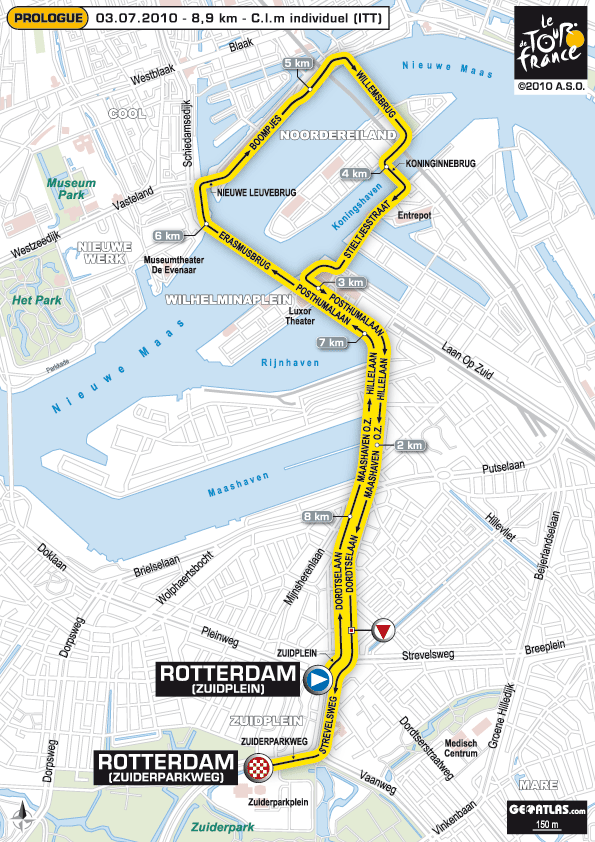
So instead of tulips in Amsterdam, as the Giro started, Le Tour kicks off in Rotterdam. Here is the route.

The other glorious thing is that little Freeview box is enough to get me live coverage whenever I can get back in time to see it. As every stage will be having some live coverage on ITV4. Seeing as there are more Brits taking part that the last time we had a British national team in the field. We have British Team Sky headed by Bradley Wiggins who equaled the best British performances last year. And the winningest Brit in any tour with six stages last year Mark Cavendish going for Green with his impressive HTC-Columbia train.

Other Brits taking part are David Millar (Garmin Transitions), Charlie Wegelius (Omega Pharma-Lotto), Geraint Thomas and Steve Cummins (both Team Sky), Daniel Lloyd and Jeremy Hunt (both Cervélo)

But titter ye not, the Tour de France to mark the 100th Anniversary of its first mountain stages is starting in the flattest country in Europe.

10 December 2009

Is Sky now no Limit for Wiggins?

Earlier this week I posted my preview of next year's Tour de France. Today comes the news that the British based Team-Sky have netted one of the two goals they were most keen to when the outfit was announced.

Sprint King Mark Cavendish may be remaining loyal to his team, indeed lead out train, at Columbia-HTC, but the other British star of last years tour Bradley Wiggins seems set to be the team leader as the team prepares for France in July, he's announced he is leaving Garmin-Slipstream to join the British outfit next year.

The three time Olympic Gold Medalist and multiple world champion on the track, finished fourth in last year's race. If it hadn't been for the return of seven time winner Lance Armstrong to last summers race, he may well have been on the podium on the day that Cav led the race over the line in the sprint on the Champs d'Elysses. Wiggo will be joining Geraint Thomas, Ian Stannard, Russell Downing, Peter Kennaugh, Chris Froome, Steve Cummings and others in flying the flag for British cycling on the roads from now on with Team Sky.

Wiggins has also said that in last year's Tour de France it was like entering the Champions League with Wigan instead of Man United. He is teaming up again with Dave Brailsford the man who has been behind the success of the GB cycling team on the track including Wiggins earlier career. Having dominated the track Brailsford now thinks GB riders can dominate on the roads. With Wiggins on the team there is a real chance of a Brit finally making the podium in Paris, we already have in Mark Cavendish the man most likely to take the Green sprinter's jersey, but he needs his team to be geared to that goal.

4 December 2009

Parcours for the 2010 Tour de France

Mister Stephen managed to get the lovely Miss Caron to watch some of this year's Tour de France. It is a little cold outside to day so what better way to warm my paws up than to think of the sunny climes of France in July when the Grand Tour is almost exclusively within France itself. For Caron and others here is a preview of the route.


Last year the race was decided on the climb of Mont Ventoux and even Miss Caron was enjoying the spectacle and acheivement as the top five in the General Classifiacation of last year launched attack after attack on that famous climb. The race last year also started straight into a stage but 2010 will see the Prologue return as the peleton race mano a mano against the clock around Rotterdam.


Stage Two includes a reverse approach of the Rosier Climb from the Liege-Baston-Liege Classic, before ending up in Spa. Two Formula One locations in two years the Tour organisers are spoiling us cross-over fans. The following stage and the entry into France will see an astonishing 13.2 km over cobbles, hopefully not enough to stop Mark Cavendish looking for what may very well be his second or third stage win of the race if he keeps up his form of last season.

The Alps appear first in this years Tour with only two days of high mountains separated by a rest day so don't expect to race to be decided as we leave the alps on Bastille Day with the run from Chambéry to Gap.

So expect the race to heat up in the Pyrenees, where there are three consecutive days of racing from 18-20, then the climb to the top of the classic Col de Tourmalet after the rest day in Pau it what looks set to be the highest Pyrenees passes second Mountain top finish.

If it is still tight at the top of the Col it may well come down after the long run into Bordeaux with the only time trail apart from the prologue on next years tour at Paulliac on the penultimate day. Then after the overnight transfer into the heart of the country from the coast it will be run up to the arrival on the Champs-Élysée on the 25th of July.

25 July 2009

After that thank God It's Over

What a stage! What a race!

The real battle of the Tour de France came down the the climb of Mont Ventoux and good choice by the Tour Organisers, the final hour of the ascent of the Giant of Provence lived up to it hype of being the place where the general classifications would be decided.

The seven heads of state Alberto Contador, Andy Schleck, Lance Armstrong, Bradley Wiggins, Andreas Kloden, Frank Schleck and Vincenzo Nibali were the ones who kept together when the big group hit the slopes above Bedoin. They started to close down the leaders up the slopes Juan Manuel Garate and Tony Martin, but that wasn't the reason for their speed.

Frank Schleck attacked a number of times, but each time he was marked by Lance Armstrong determined not to cede his third step on the podium. When little brother Andy attacked it was the Maillot Jaune on the back of Contador that came with, but when Frank didn't follow he sat up. Obviously more determined to help his brother get a leap on Armstrong rather than try and get the 4'11" he needed over the man who was covering his every move.

Kloden was the first of the big 7 to suffer and slip off the back. But Nibali and Wiggins also at times seemed to struggle to get back. But over and over again 6 of the heads of state kept together. Kloden any time he thought there was a hope of getting back on the back wheel suffered as another acceleration pulled them away again.

Then in the final two kilometres Andy went again this time with brother Frank on his wheel. Armstong and Contador went with, but Wiggins seemed unable to respond. Was this the time that more British hopes were to fade, almost at the point when the memorial marks the death of Tom Simpson on the same slopes. But no Wiggins kept digging in finding reserves from somewhere.

At the line Garate crossed first, then Martin. Then the three leaders of the race A. Schleck, with Contador and a three second gap to Armstrong. But with Kloden down the road the only real gap that mattered was going to be between Frank Schleck and Bradley Wiggins. At 43" after Garate the elder Schleck crossed the line Brad had to get there before the race showed +1'06". Then on the left hand side of the road almost out of view of the camera Bradley Wiggin's reminiscent of Steven Roche he appeared crossing the line at +1'03" twenty seconds lost but 4th place retained for the procession towards the Champs-Éylsées tomorrow.

Of course the Brits have had a good tour David Miller has been doing sterling work, and just missed out on the run into Barcelona of individual glory. Wiggins of course has ridden high up the GC and has given hope of making a podium in Paris in the years to come (why did that Texan have to come out of retirement this year?). But a little man from the Isle of Man is going for 6 tomorrow. If only he hadn't been disqualified on the run into Besançon we may still have seen him and Thor Husovd competing the two intermediates as well as the final bunch sprint on the Champs-Éylsées tomorrow.

But as it is Britain's top stage winner Mark Cavendish and equal top finisher Bradley Wiggins can look forward to Paris tomorrow one to relax the other has one more goal, to be the first of the men to cover the 3252km of the 96th Tour de France, even if only by a few yards and hundredths of a second.

Crunch Day on Ventoux

Today is the day that the general classification will finally be settled in this year's Tour de France and for the 8th time in Tour history it will act as a mountain top finish. The roll of honour to win on the summit reads like a history of worthy post war recipients.
  • 1958 Charley Gaul Luxemborg Individual Time Trail (Champion 1958, King of the Mountains 1955, 56 )
  • 1965 Raymond Poulidor France (8 times on podium 3 times each behind Anquetil and Merckx)
  • 1970 Eddie Merckx Belgium (5 Time Champion 1969-72, 74)
  • 1972 Bernard Thévenet France (Champion 1975, 77)
  • 1987 Jean-François Bernard Individual Time Trail France
  • 2000 Marco Pantani Italy (Champion 1998)
  • 2002 Richard Virenque France (Most successful King of the Mountains (1994-7, 99, 2003-04)
  • 2009 ???
But what makes Ventoux special? It is not the tallest, not the steepest but has a mystique all of its own. It stands out on the horizon however you approach its 1912m summit. Indeed from the feed station at78km into today's 167 km stage the riders will start a circuit around it. Admittedly that circuit will include the 4th category Col de Fontanbe and 3rd category Col des Abeilles. Certainly the Mont holds a little bit of a psychological hold over the riders.

But it is the 21 km ascent to the summit from Bedoin to the peak that is the real test. It starts in the airless forests at the base before exploding into the barren lunar landscape at the peak. From Saint-Esteve at 5 km up the climb to the peak (with only brief respite through Chalet Reynard and the treeline) it is greater than 6% climbing and for long stretches greater than 95 all the way to the top.

Ventoux was first climbed in the Tour on 22 July 1951 when it was including in the 17th stage from Monpellier to Avignon. On that occasion a lead group of 12 were together at the foot. At Chalet Reynard Hugo Koplet attacked*, only Raphaël Géminiani**, Luison Bobet, Gino Bartali and Lucien Lazardes*** could stay with him. 2km from the summit Lazardes attacked and reached the top alone followed by a lone Bartali and thus was Ventoux first conquered in the Tour.

Its not just the breaks but the mountain that has claimed men. In 1955 Jean Malléjac who had finished second two year previously was described 10km from the summit "Streaming with sweat, haggard and comatose, he was zigzagging and the road wasn't wide enough for him... He was already no longer in the real world, still less in the world of cyclists and the Tour de France". He collapsed as was taken to hospital struggling and shouting after regaining consciousness on the side of the road.

The same year Swiss racer Ferdi Kübler was setting such a vicious tempo that Géminiani survivor of that first ascent warned him off. Advise he ignored to his cost. He started to struggle in the last kilometre of the ascent and fell repeatedly on the descent finishing 26 minutes back on the line for his efforts on the climb.

In 1967 the British cyclist, that Bradley Wiggins is most closely competing with for prestige in the major tours, Tommy Simpson came to his own fate. He began weaving across the road in the last kilometre and fell twice. The tour doctor Pierre Dumas reached him after the second collapse spent more than an hour giving him heart massage and mouth to mouth. But realised he was dead and had him removed from the mountain by helicopter to Avignon where the cyclist was pronounced dead at 17:40. Of course Simpson's death is an object lesson on how the drugs don't always work.

So what of today's stage. Alberto Contador may well have a 4'11" lead over Andy Schleck but this is the sort of stage that that might be clawed back, especially as tomorrow there is just the gentle roll into Paris to come.

The Schleck brothers will well be aware that their fellow countryman Gaul was the first winner on the summit here. Older brother Frank will need to do something to climb back unto the podium. He'd gained that spot on stage 17 on the Col de Colombiere but lost it the following day on the TT around Lac d'Annecy. Expect him to attack at some point on Ventoux.

As for younger brother Andy lying in second he may go with his brother, and they may launch tandem attacks to see it Contador has anything to give. If they can get a gap then it is just a matter of how big they can get it. Although he may well already know that Contador is not going to be beaten this year, but then Ventoux does await.

As well as Frank Schleck wanting to get back unto the podium don't forget that Bradley Wiggins is sitting just 16" behind that spot over a man he has climbed better than on a couple of mountain finishes this year. But that man is the man who came second to both Pantani and Virenque on those other two Ventoux top finishes this decade and in that 2002 pursuit of Virenque set the record for the fastest ascent at 50 minutes. He also has the small matter of 7 successive victories in this race to his name, so don't rule out Lance Armstrong from the challenge of Frank Schleck, Wiggins or Vincenzo Nibali just yet.

Today is going to be a very interesting day and coverage live on ITV4 starts at 13:00 BST but it already underway by text on the BBC website.

*The eventual winner.
**That year's eventual King of the Mountains and 2nd overall.
***Who would be first when the Tor reached Paris.

18 July 2009

Is Cavendish DQ French Revenge for TeamGB on Track?

Hushovd and Cav having words after the line
Here are some facts:

  1. Thor Hushovd rides for the Cervelo Testteam in the Tour de France
  2. In most of the bunch sprints he is not to be found on his own lead out man's wheel* but that of Mark Cavendish's team Columbia Highroad
  3. Thor has yet to beat the speed of Mark Cavendish in a straight sprint to the line this Tour de France**.
  4. On today's stage into Besancon the barriers are narrowing as the sprint gets towards the end instead of staying consistent; see here.
  5. Mark Cavendish has always gone to the right when Mark Renshaw peels off to launch his final push to the line (Hushovd knows this see point 1 he's always in the prime spot to observe)
  6. There have been occasions of leaning in sprint finishes in the past has not led to disqualification.
  7. The head race commissaire has announced that once he makes a decision it is final. There is no right to appeal. However, a few days ago the morning after he made a decision that there was a split in the peleton he changed his mind overnight and reinstated 15 secs that many including Britain's Bradley Wiggins had been docked on the line.
  8. This is the second incident in which a British cyclist in jersey contention has been penalised by French cycling officials in this year's Tour.
  9. France have repeatedly been losing out to Team GB cyclists including Wiggins and Cavendish on the track in recent years.
  10. The Tour while under the auspices of the UCI is also somewhat a law unto itself at times (which is both good and bad at times).
One does wonder if it had been Tom Boonen against Hushovd whether a disqualification would have been the decision, or whether a reversal of line placings (an alternative penalty) would have sufficed, or even if the result would have held.

Why did the course at the end narrow so much? Could the race not have stopped further up the road if the road was wider there? Have the race officials noticed they have got the course wrong on this occasion but are afraid to admit their mistake? Does it have anything to do with the ongoing success of British cycling?
I may be a little cynical but both of the controversial line decisions in this weeks tour have affected British racers. Brad Wiggins was less that 20 metres behind Lance Armstrong, 5 positions in that 'split' 15 seconds may well have be enough to prevent him doing anything in the General Classification. On the last sprinters stage before the Champs Elysees was the finish made deliberately tighter on Cavendish's launch side, thus effectively ending the close Green Jersey contest?

UPDATE: Just like to say that a number of the anti-Cavendish comments on Twitter this evening are homophobic in nature. Our use of language really needs sorting out.
UPDATE 2: Here is what Robbie McEwen, an experienced Tour Sprinter who was also robbed of a final Green Jersey, had to say via Twitter:
18:32 Cav didn't really move much, barrier did but his looking over shoulder lining up Thor is what judges would have dq'd him for. full dq harsh
18:33 most they should have done if anything was reverse placings.
18:54 re:Cav DQ.Trying analyse impartially-both mates of mine.Calling it like i see it.Sprinting tactically is very fine line.I lost a green by DQ
18:57 if Cav hadn't had a look, he wouldn't been DQ'd I think. Fine line.again, total dq is OTT. shame to ruin a gd battle. gd luck to both

*Indeed does anyone know who that is?
**Barcelona where Thor did win beating Cavendish in the same group was a tough uphill finish.

4 July 2009

Liberté, Fraternité, Echappée*

The news this morning that the Statue of Liberty will mark Independence Day with public being allowed to the crown from the first time since 9/11 is good news. It also coincides with the start of Le Grande Slog across France, Spain, Andorra, Switzerland and Italy towards her sister who sits on another Isle in the capital of the country of her birth. The full route is shown visually below.


On the 40th Anniversary of the moon landings is suitable marked with the penultimate stage up through the lunar landscape to the peak of Mont Ventoux, though it is 4 days late on the 25th to be a really fitting tribute for the day that there was 'one small step'.

Today however many Formula One fans will recognise parts of the course for the opening individual time trial of the 2009 Tour. Indeed the finish line is more used to the checkered flag than the kite marking Arrivée, and the Flamme Rouge marking a kilometre to go is in a very famous tunnel. They even race past the Casino though not through the iconic square. The pit lane instead of having mechanics working on cars will have mechanics doing last minute tweaks to machines about to ride up the the depart hut for 15.5km course that will take them up the steep climb of Moyenne Corniche to the high point a Category 4 climb of Côte de Beausoliel 2o5m up.

For the Grand Départ is taking place in the streets of Monaco some of it very familiar to speed fans of the four wheeled variety. See below for a full look at today's course.


*Translation of Title: Liberty, Brotherhood and Breakaway Group.