23 October 2013

Le 101eme Tour de France Parcours #TDF2014


There are 255 days until the 101st edition of the Tour de France. As we already knew it spends the first two day winding its way around Yorkshire, then on the third day travels from Cambridge to London, but today the remainder of the route was announced. Five of the nine new stage start/finish towns are in the UK Leeds, Harrogate, York, Sheffield and Cambridge.

It will go clockwise around France this year meaning that the Alps will come before the Pyrenees.  But before the first rest day they will already have been in a French mountain range as stage ten returns to La Planche de Belle Filles a key stage to both the last two Tour winners. It was here in the Vosges mountains that Bradley Wiggins gained the yellow jersey in 2012 never to give it up and Chris Froome won his first stage in the Tour.
 
The Arenberg Trench
There are nods to history and the classics with Stage 5 which starts 100 years after the start of World War I in Ypres but will finish in Arenberg Port de Hainaut. Arenberg is famous for cycling fans for the Arenberg Trench 2.4km of pavé (cobbles) that can often prove decisive in the Paris Roubaix spring classic. Expect some cobbles to feature on this 9th July stage.

Ypres is the first of the new French stage towns. The next will feature on the stage after the first rest day as the tour travels from Besançon to the rugby mad town of Oyannax in the Jura mountains.

Froome and Porte climb to Risoul in 2013 Critérium
Entering the Alps there will be a new ski resort to visit on stage 14 when Risoul hosts the finish, it featured in the 2013 Critérium du Dauphiné so is known to champion Froome. It will be reached via the
Col du Lautaret making its 41st Tour appearance since 1947 and Col d'Izoard making another of its frequent appearances. Who will add their name to amongst others Fausto Coppi, Louison Bobbet and Eddy Merckx, it will be a lesser name as I expect there will still be a breakaway ahead of the GC contenders at this point of the race.

The Pyrenees, however, should be where this race is decided and they start on stage 16. The Portet d'Aspet and Col de Ares act as appetisers before the infamous Port de Bailes and the long 21.5km descent into the Bagnères-de-Luchon finish. Next day sees the Col du Portillon, Col de Peyresourde and Col de Val Louron-Azet before climbing to the Pla d'Adet making its first appearance since 2005. However, Petresourde and Val Louron-Azet featured in the stage that after Froome gained the yellow jersey last year he found himself having to chase down moves himself without protection. He will be hoping not to find himself in the same sort of position again this year if he is in the Maillot Jaune.

Hautacam in 2000
The final Pyrenean stage only features two mountains but they are the Tourmalet and Hautacam. Tourmalet will be making its 83rd appearance in the Tour and five of the last seven men to reach its summit first have been French. Hautacam was made famous in 2000 for the way that Lance Armstrong played with his rivals before attacking to set up what appeared to be his second win in Le Tour.

The only time trial stage comes on the penultimate day from Bergerac to Périgueux. It is relatively long at 54km that is a time trial specialist has kept relatively close to the pure climbers could turn the race on its head. But this tour is most definitely designed for climbers. Even though there are only 6 mountain stages five of these are summit finishes.


7 October 2013

Giro d'Italia 2014 - Il Percorso

So today was the most excited I have ever been about the announcement of the route of 2014 Giro d'Italia. The fast that the 97th edition of the race will start here:

Titanic Quarter, Belfast
But also as well as spending three days in Ireland, which necessitate a start on Friday 9th May so that an extra 'rest'/transfer day to get the race back to Italy, there are some very interesting stages.

There is the Passo de Lupo, which only counts as a 10.6km climb despite having had to climb to the start of it on stage 9 to be a tough finish before the second rest day on the 18th May. But the race will only get harder from there on.

There are the 18.3km climb of Bielmonte, 11.8km of Oporo both on stage 14 which could well start to open up the race. The 18.6km climb to Plan di Montecampione on stage 15 just before the third and final rest day.

But after that rest day there will be 60km of climbing on stage 16 taking the Giro over the highest mountain pass in the Eastern Alp the Stelvio, but it is only the middle of the stage with Val Martello Martelltal still to come to complete the stage. Stage 18 will feature  Passo di San Pellegrino (11.8 km) and finish on Panarotta (15.8 km). The next stage is a mountain time trial it is only 26.8km long but the last 19.3 of those are the climb of Monte Grappa.

If the Giro is still up for grabs on the last day the race might well be decided on Monte Zoncolan, and the stage called Welcome to Hell.

The tough climb has only appeared four times in the Giro making its debut in 2003 and appearing again in 2007 and being a summit finish in 2010 and again in 2011 (despite protests about a last minute route change). It has a long way to measure up to the history of the Stelvio (which appears in the middle of stage 17) but has already got a reputation for hardness that will continue to make it one to watch. It is only 101km long so not the longest, but the average gradient is 11.9% as the riders will climb 1203m. The maximum gradient is 22%.

It will certainly be a climbers Giro with the tough final week in the high mountains, but there is something for the sprinters. Mark Cavendish could well be targeting his first Grand Tour stage win on UK soil for stage 2 in Belfast, but Dublin on stage 3, Bari stage 4, Salsomaggiore Terme stage 10 (although a little lumpy in the run in), Rivarolo Canavese stage 13 and if they survive the mountains there is Vittorio Veneto stage 17 and the ride into the finish at Trieste. Along with the finish toFoligno on stage 7, which has a tough ramp near the end, but might still be available for the tougher sprinters, that gives 7 or 8 opportunities where the sprinters could shine. After his five stages wins from last year it will interesting to see what Mark Cavendish can do this time.

You can see a preview of the full percorso here:

2 October 2013

Giro d'Ireland: Giro d'Italia 2014 Grand Depart #GirodItalia #Giro2014

So yesterday the planned route for the Grand Depart of the 2014 Giro d'Italia from Belfast were announced. In all the race will spend three days in Ireland before heading to Italy for pastures more familiar than new.

But

Day 1
 The opening day is over roads I know very well. Some I have run along as part of 10ks or the Belfast Marathon and some I have taken my lunchtime walk along.

It is a 22km time trial which starts at the now iconic Titanic Experience before heading over the bridge to go up the Newtownards Road all the way to the Stormont Estate, they will head up the Prince of Wales Avenue giving the trailing camera bikes the iconic view of the white front of Parliament Building in front of the riders before they exit the estate to the east.

Then it is back in along the Newtownards Road over the Lagan and although near the finish the cyclists will take a loop out past the Waterfront Hall down the Ormeau Road along the Stranmillis Embankment and back in to the city centre past Queen's University to finish outside City Hall.

Now some have complained that the route doesn't include West Belfast, but it certainly ratchets up a whole host of landmarks and Belfast shorthand in a short 22km stage.

Day 2

After showing all the icons of Belfast off on the opening day, day two will cover some of the icons of Northern Ireland and the most beautiful road into the bargin.

The route will leave Belfast and head as directly as possible to the North Coast. Arriving past the oldest licensed distillery in the world at Bushmils. Then it will turn East along the Antrim Coast Road past the Giant's Causeway, then on the somewhat lumpy route through the Glens with some beautiful vistas across some valleys and through some rock arches.

The road will become relatively flat as it approaches Larne when it starts to hug the coast more, but there will be a few little hills such  as at Whitehead, when it returns to the shores of Belfast Lough, heads past Carrickfergus Castle and back into Belfast for what should be a sprinters finish. Is it too early for me to predict that Mark Cavendish's first win on British soil in a Grand Tour will come on this stage?

Day 3
 The final day in Ireland is a cross border affair as it crosses the UK's only land border with another EU member state.

It starts out in the city of two cathedrals, Armagh, the seat of the Angligan and Roman Catholic Archbishop Primates of All Ireland. The route will meander through south Armagh and south Down, sadly not taking in the Mournes, but then the roads there don't go over the high points.

It will cross the border near Newry and then head to Castlebellingham where the troops of William III camped on the eve of the Battle of the Boyne. James II had razed the building as the result of Bellingham acting as a guide to William. It will head on through Balbriggan which received notoriety in the war of independence when the Black and Tans sacked the town destroying 54 houses and the hosiery factory.

On a day that will give commentators plenty of Irish history to talk about the race will end in the other capital city on the island having finished in the other one of the last two days.

I'm looking forward to welcoming the Giro to Ireland and am thinking about where I'd like to watch it pass on each of the three days.

27 September 2013

III Winter Olympic Games: 1932 Lake Placid

In the run up to London 2012 I did a series looking back at all the previous Olympics posting it at 5pm every Friday, I've decided to do the same in the run up to Sochi 2014 with the Winter Olympic Games. You can catch up on any you missed in the Olympiads Revisited tab.

The Winter Olympics like their Summer counterparts left Europe for the first time on their third edition and headed to the USA. Indeed if Melvil Dewey, inventor of the Dewey Decimal System for libraries, hadn't established the Placid Park Club in the area in 1895 and developed it as a winter resort as well from 1905, it may well have been the North Elba Olympic Games, but the people of the village changed the name to fit with the Country Club that Dewy had founded.

Competitors 364 (-100)
Nations 17 (-8)
Events 14
Sports 4

4 February to 19 February 1932 hosted by Lake Placid, NY, USA

The move from Europe did however see less nations sending teams to the Games and less athletes participating, much as has happened in the 1904 Games in St. Louis. Estonia, Latvia, Lithuania, Luxembourg, Netherlands and Yugoslavia didn't send teams from Europe, but Argentina and Mexico surely didn't have the excuse of cost, time and distance as a deterrent having travelled to Europe for the last Games.

The Games were opened by the Governor for the State of New York, where Lake Placid nestles, Franklin D. Rossevelt, in November of that year he was elected to serve his first term as President of the USA. As with the first Winter Olympics and the planned Games for 1936 and 1940 the Winter and Summer Games were to be held in the same nation.

Mass start dumbfounds the European skaters


A mass start at the Lake Placid Games
Speed skating at the time was done in two different ways, in Europe, as we still see in long course, it is two people against each other and the clock with controlled changing of lanes. Yet in the USA and Canada it was a mass start and every man (although women took part in a demonstration at these Games) for himself, much like the short track speed skating at the modern Games.

Whether or not the mass start affected events it is hard to tell but the All Around World Champion and defending 5000m Olympic Champion Ivan Ballangrud of Norway could only manage one medal, a silver in the longest event the 10,000m by only 4.5m having just passed Canadian Frank Stack towards the end. He was behind Irving Jaffe, who had been leading the 10,000m four years earlier in St. Moritz when the competition was abandoned as the ice on the lake where it was being held was melted. Jaffe had also taken Ballangrud's 5000m title.

In the shortest distance the 500m only Norway's Brent Evensen even made it through the heats to compete against an all USA or Canadian final. In the 1500m only the North American nations were represented in the final and Eversen and Ballangrud were the sole Europeans to break the USA and Canada stranglehold of representatives in the 5000m and 10,000m finals.

Indeed it was only another silver from Evensen in that 500m alongside Ballangrud's in the 10k that prevented all the medals either staying the in USA or heading just across the border to Canada. But not even Canada could stop all the gold staying in the USA.

In the 500m and 1500m Jack Shea became the first American to win two golds at the same Winter Games. He was also the the first of three generations of Olympians from his family, his son Jim took part in 1964 in cross-country skiing and Nordic combined and his grandson Jim Shea Jr was to win the gold in the men's skeleton when it became a permanent fixture in the Games in 2002.

Women speeders break unto the ice
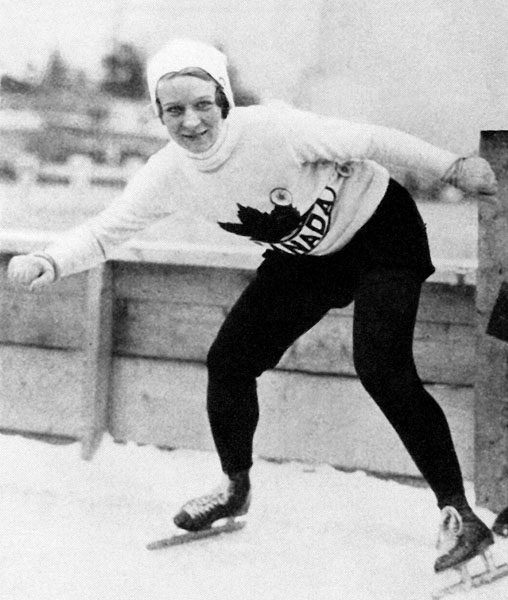

Jean Wilson of Canada
Lake Placid was the first time women took part in anything other than figure skating at the Winter Olympics. although it was only in a demonstration capacity in the speed skating and only over three shorter distances 500m, 1000m and 1500m.

In total 10 women, five each from the USA and Canada took part in these events.

The 500m winner was the sole winner from Canada, Jean Wilson. She had actually been born in Glasgow in 1910 before her family emigrated to Canada. She also took silver in the 1500m and was leading the 1000m before a fall denied her a medal, Elizabeth Dubois who came behind her in the 500m taking that gold. However, after the Olympics she developed the auto immune disease myasthenia gravis and died on 3 September, 1933. 

The winner of the 1500m was Kit Klein of the USA, four years later at the World Championships in Sweden she was able to prove that women were capable of skating further than they had been allowed in 1932. She managed to take 10 seconds of the 3000m World Record in that event. The following day she was 36 seconds under the pre-existing World Record for 5000m only to have had Verné Lesche of Finland skate faster. However, Klein had secured the all around title, but as she was sailing back from Europe after the 1936 Games in which there was no women's speed skating she threw her skates overboard marking her retirement.

From swimming to skating
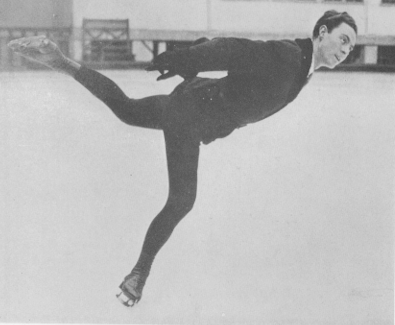

 Karl Schäfer winning the first of his Olympic titles
The winner of the men's figure skating, Karl Schäfer, was  competing in his third Olympics. He had just missed out on the medals in skating four year's before when only 18 but had gone on to Amsterdam to take part in the 200m breatstroke for which he was also a multiple Austrian champion. He missed out in the semi-finals while the Filipino swimmer, Teofilo Yldefonzo, who he had beaten in the heats went on secure his nations first Olympic medal with a bronze in the final.

Four years on having been unbeaten as European Champion since 1929 and World Champion since 1930 he was favourite to win in Lake Placid despite the three time Olympic Champion Sweden's  Gillis Grafström being in the field of twelve. Grafström was 38 to Schäfer at 22 and hadn't been tested in a major competition since his final World Championship in 1929. The younger man won both the compulsory figures and free skating with the Swede coming second in both to claim the silver medal in his fourth Olympic ice skating event, including the inclusion of figure skating at the 1920 Summer Games.

Schäfer would go on to defend his title in 1936 before retiring from competitive skating, having won the European title 8 years in a row, the Worlds 7 years and two back to back Olympic titles.

Four in a row, O Canada?
In white, the Winnipeg Hockey Club represented Canada

Yes I know this is only the third Olympic Winter Games but like Figure Skating, Ice Hockey had made an appearance in 1920. Since then the title had been the property of Canada and nobody apart from the USA had even managed to keep them within 5 goals of a difference.

As in 1920 when the Winnipeg Falcons took the first Olympic Ice Hockey gold, the Manitoba city provided the team to represent Canada, this time Winnipeg Hockey Club. In Lake Placid there were four teams entered with Germany and Poland making up the numbers with each team playing the others twice. 

The first and last Games were to be USA v Canada. In that first game Canada took the lead in the second period, but the USA scored an equalising goal in the third period of normal time. So for the first time in Olympic history Canada had failed to win in the time. It was also the first Olympic ice hockey game to go to overtime. Canada were the eventual winners with a goal in the second period of overtime.

With Canada and the USA winning all their other games it came down to the last game to determine the gold and silver. Germany had secured the bronze after beating the Poles in both their matches. Both teams scored in the first period but USA scored in the second, this was the first time that Canada had been behind in an Olympic ice hockey match in history. They did however, score in the third period to force the teams once more into overtime. Neither team could score in the two allowed periods of overtime, making this the first ice hockey match to be a tie in Olympic history. But it was enough to secure the fourth gold in a row for the Canadians.


Faster, longer, steeper


Lake Placid's first bobsleigh track
These are three words than can best sum up the Olympic Bobsleigh run that was purposefully built in Lake Placid for the 1932 Games. Studies were made by the Organising Committee of the best runs in Europe at Chamonix, St Moritz, Grindelwald, Mürren, Engelberg and Davos. They had surveyed a run with a vertical drop of 200m compared with 156m at Chamonix and 130m at St. Moritz.
In the end the Lake Placid track suited the American racers to a tee. Billy Fisk repeated his gold medal winning performance from 1928 driving in the now recognisable four-man event, while Hubert and Curtis Stevens (not related) took gold in the inaugural two-man.

However, the committee were looking ahead at single coasting events, whether toboggan or skeleton for the Olympics. In their proposal to the IOC (page 51)  they said:


"Single-sled coasting of various forms is, however, a feature on most bob-runs, and would seem to be an interesting and appropriate feature for the Olympic Winter Games. It is suggested, therefore, that if single-sled coasting be desired as a feature of the Third Olympic Winter Games, it be held on the Olympic bob-run, without restriction as to the exact form of sled. If the International Federation of Bobsleigh and Tobogganing desires a smoother, faster ice surface for the single-sled event, this can readily be provided by holding the single-sled event at the beginning of the Olympic period and re-icing the surface for the bobsleigh event to be held toward the close of the Olympic period."

In the end, apart from the return of the Games to St. Moritz and a second skeleton event on the Cresta Run there was no introduction of single-sled coasting events until the introduction of the luge in 1964 and the permanent inclusion of the skeleton from 2002. Putting the men behind the 1932 games 30 and 70 years ahead of their time.

Dogs have their day in Lake Placid


The only time dogs have taken part in the Olympics
While horses had made their sole Winter Olympic appearance in 1928 in skijoring it was the turn of dogs in 1932. Again it was only as a demonstration event that dog sledding made its appearance on the Olympic stage.

American and Canada were well know for their dog-sled racing coming out of the practical need to get around over the vast distances in the frozen north during winter. Lake Placid itself had been holding an annual race ahead of it being awarded the Games.

In the end the two top sledders of the day Canada's Emile St. Godard and USA's Norwegian-born Leonhard Seppala would be the class acts over the 40.5km (25.1 miles) course. The actual event was held over two days a fortnight before the Games commenced.

In the first run St. Godard had an advantage of just 91 seconds over Seppala both of them being some 13 minutes ahead of the rest of the field. Seppala however, lost a further 6.5 minutes on the second run when St. Godard was again the fastest.

26 September 2013

USA win America's Cup with a little help from a Brit

If you had gone further south down the Californian coast last week with the script of this year's America's Cup even the great and the good of Hollywood would have too you it was too far fetched to be turning into a film. Now they will be falling over each other to turn one of the greatest come backs in sporting history into something to show at a cineplex near you.

Last Wesdnesday Team Emirates New Zealand secured their eighth win of the series, they needed just one more. Team Oracle USA with three wins were only on one point, they'd had two reduced before the start of this regatta due to irregularities in the America's Cup Series races leading up to this event. The original tactician on the USA's boat John Kostecki had been replaced after the fifth race with New Zealand having taken four wins that far, but who should step in, but sailing's most decorated sailor quadruple Olympic gold medalist Sir Ben Ainslie, bring the total of gold up to five alongside strategist Tom Slingsby aiding skipper and helmsman James Spithill.

Now remembering that the history of the event starting when the Americans defeated the British, having a Brit come in to the USA team in such a key role had historic implications. No Brit had been on a winning boat in the series since 1903, when my local yacht club the Royal Ulster Yacht Club was the unsuccessful challenger with Shamrock III. But even with Ben on board things didn't go all smoothly. In his first six races settling in while USA won two New Zealand soared to four more wins. So it was that USA faced the prospect of winning 8 races on the bounce, one error and a race going to the Kiwis would end their challenge. Nobody back then thought it was possible.

On the 14th September with the score 6-0 and the Kiwis leading the race was cancelled in strong winds, so it could actually have all already been over. But the fight back did begin, 8-1 down the USA won the next race. But the next time a start was called good was in light winds and the code zero sails went up in the downwind legs. New Zealand were well in the lead rounding the last gate and heading for home, but the race exceeded the 40 minute time limit for a race.

Over the next four races USA kept winning the start and the beat to gate one. Leading to the events on Tuesday. In the first race, New Zealand were penalised at the start gate for not giving right of way to USA. It was enough to see the Americans power ahead to the first mark and a 150m lead that never seemed to be cut into for the rest of the race. In the second race though New Zealand did something they hadn't for a while and won the start. They pushed America off course and into a halt, before zooming away to the second mark. But on the third leg something phenomenal happened, the USA not only ate away at the lead but took a huge chunk out of it. At the turn they had managed to take a 300m lead which expanded on the run for home back up the course.

Ainslie at the help while Skipper Jim Spithill celebrates
So it was to the final race a winner takes all that we all turned yesterday. New Zealand again managed a better start and near the first mark Team Oracle USA actually hit a hole in the wind and her bows went under the water as they started to make the turn. It became a drag race up the second leg, But Team Emirates New Zealand took the next mark in the lead. But on that third leg yet again the Americans managed to grab the lead as they split the course, and with each subsequent cross they found themselves further ahead.

Today Ben is talking about how much he wants a British Challenger to come to San Francisco for the next time. We have some excellent sailors and designers who could make us a competitive boat that will undoubtedly be skippered by the man with that America's Cup experience and four times gold medalist. The one yachtsman who will not be part of a British challenge will sadly be Andrew 'Bart' Simpson who sadly died in a training accident on the Swedish challenger Artemis earlier this year.

15 September 2013

Vuelta a España Stage 21: Leganés to Madrid

Yesterday the clouds and mist descended on the final climb of the 2013 Vuelta a España.

On the climb of the Angliru the first of the top ten to get dropped was Leopold Konig (TNE). Then on the first ramp of the steepest part of the climb Vincenzo Nibali launched an attack. But he was was brought back, and then he attacked again. But by now it was only the Chris Horner (RSL) led trio with Alejandro Valverde (MOV) and Joaquim Rodriguez (KAT) who could retain his wheel. But as the mist came down and the crowds closed around it was soon time for Horner to go to the front and press on.

First Valverde dropped off the pace a little, but pulled back, but then Rodriguez and Valverde both fell a short gap behind Horner and Nibali. But then out of one corner Horner launched an attack and Nibali appeared to have stalled. The gap was established and was only going to increase from there to the line.

In the end as the GC contenders had been making their way through breakaway riders only Kenny Elissonde (FDJ) was able to stay ahead. But next over the line some 26 seconds later was Chris Horner taking some vital bonus seconds and the clock then ticked over to see what sort of lead he would have. Valverde was leading the chase group and Nibali could have sprinted for the extra seconds for third. But when they crossed the line some 28 seconds further back it was Valverde who took the only remaining time bonus.

Rodriguez came in 1'45" behind the stage winner, Domenico Pozzivivo (ALM) 2'20" and Nicolas Roche (TST) 3'42" down. So the final GC should look like this:

  1. Chris Horner
  2. Vincenzo Nibali +37"
  3. Alejandro Valverde +1'36"
  4. Joaquin Rodriquez +3'22"
  5. Nicolas Roche +7"11"
  6. Domenico Pozzivivo +8'00"
  7. Thibaut Pinot (FDJ) +8'41"
  8. Samuel Sachez (EUS) +9'51"
  9. Leopold Konig (TNE) +10'11"
  10. Daniel Moreno (TST) +13'11"
So along with being in the red jersey Chris Horner also has the white jersey for best all around rider, Valverde remains in the Green for points leader and Nicolas Edet (COF) has done enough to win the king of the mountains. Euskaltel- Euskadi who were dead before the start of La Vuelta have emerged as the best team some 1'02" ahead of Movistar and with a saviour in the shape of Fernando Alonso.

Today's final stage will be a mainly ceremonial loop around the capital from Leganés before heading back into the centre of the city and a 5.7km circuit taking the race over the finish line 8 times before opening it up for those sprinters that have survived this tough race to fight it out.

The race is over for the GC contenders but too many times this race the sprinters teams have lost out on what should have been a stage to showcase their sprinters. Maybe finally in Madrid there will be a final bunch sprint which isn't chasing down a last few lone escapees.

Then when Chris Horner crosses the line he will not only be the oldest man to complete La Vuelta but will also be the oldest man ever to win a Grand Tour race.

14 September 2013

Vuelta a España Stage 20: Avilés to Alto de l´Angliru

Yesterday was a day that saw the race for the red jersey heat up once again. With only three seconds separating Vincenzo Nibali from Chris Horner at the start of the day it was always going to serve up that potential. Ahead of today's final competitive stage for the GC contenders it was always going to be a tense affair.

On the final climb of the day the first rider to attack was Jose Joao Mendes (TNE), not someone to be feared. But the pace of the Team SaxoBank Tinkoff riders brought him back and that allowed their leader Nicolas Roche to launch his own attack. However, before they caught him Thibaut Pinot (FDJ) had been dropped by the pack.

Michele Scarponi (LAM) was the first to respond to the Irishman's attack. But then it was Joaquin Rodriguez (KAT) who stepped up the pace in the last km overhauling them both and pulling away for the stage way and the bonus seconds for coming first. Behind him taking the other valuable bonus seconds were Diego Ulissi (LAM) at 11 seconds and Daniel Moreno (KAT) on the same so none of the GC contenders picked up bonus time. Samuel Sanchez (EUS)  had finshed with Ulissi and Moreno.

Then it was:
  • Chris Horner (RSL) +14"
  • Alejandro Valverde (MOV) +14"
  • Michele Scarponi (LAM) +16"
  • Leopold Konig (TNE) +20"
  • Vincenzo Nibali (AST) +20"
  • Nicolas Roche (TST) +23"
  • ...
  • Domenico Pozzivivo (ALM) +33"
  •  ...
  • Thibaut Pinot (FDJ) +1'05"
The net result is that the race is still lead by only three seconds, but this time it is the gap that Horner has over Nibali rather than the other way around at the start.

Today although the stage is 142.2km long it will come down to the last 13 of these, 12.2 of which are the climb of Alto de l'Angliru (pictured).

There is a particularly tough section near the summit between 4 to 2km left to race and this is where time gaps will open up between those guys who think they have a chance can make up time. Rodriguez showed yesterday what he can do on an explosive climb and along with the bonus seconds for coming first he might well be able to make up his 1'57" on Horner. Valverde sitting only 1'06" back will probably have to go before or with Rodriquez and hope that Horner is on a bad day, but that gap could also be reduced on the upper reaches today. Horner may burn himself out trying to match the other two and allow Nibali those vital few seconds even if it is just from a top three finish ahead of him to steal back the red jersey.

The only hope for Roche who is 3'49" back would be for a long attack far down the climb before the others are ready, but unlike in recent days he is going to have to keep going at the pace that they are going at, if not faster to make sure he can the time he needs.

It will be a tough day but the one that will final determine which man will win the 68th edition of La Vuelta a España.

13 September 2013

I Olympic Winter Games: Chamonix 1924

In the run up to London 2012 I did a series looking back at all the previous Olympics posting it at 5pm every Friday, I've decided to do the same in the run up to Sochi 2014 with the Winter Olympic Games. You can catch up on any you missed in the Olympics an Anthology tab.

The 1924 Summer Olympics were to he held in Paris, France. In the 1908 and 1920 Summer Games Figure skating had featured and in the 1920 Ice Hockey had also taken part. In 1921 the decision was made to have Semaine Internationale des Sports d'Hiver (International Winter Sports Week) at Chamonix as part of the Paris Games.

Although the idea of a Winter Sports Week associated with the Olympics was not a new one. It has first been put forward for 1912 as part of the Stockholm Games, but was turned down by the hosts as there already was the multi-event Nordic Games first held in Sweden in 1901, which would continue to run until 1926 with only one of the eight held outside Sweden; Norway 1903. There was meant to be a Winter Sports Week in 1916 when speed skating, figure skating, ice hockey and nordic skiing would have taken place at a German winter sports venue, but the war intervened.


Nations 16
Competitors 258
Sports 9
Events 16

25 January to 5 February, 1924 hosted in Chamonix, France

The original nations to take part in what were to become the Winter Olympics were:

  • Austria
  • Belgium
  • Canada
  • Czechoslovakia
  • Finland
  • France
  • Great Britain
  • Hungary
  • Italy
  • Latvia
  • Norway
  • Poland
  • Switzerland
  • Sweden
  • United States
  • Yugoslavia
The nine sports that were represented being bobsleigh, curling, figure skating, ice hockey, military patrol (aka biathlon), nordic skiing and speed skating. Perhaps surprisingly to us today the Alpine Skiing wasn't to feature until 1936.

First gold...

Winner of the First Winter Olympic Gold Medal
On the second day of the Games the first gold medal was awarded in the 500m speed skating.

The winner of that first gold was a native of Lake Placid a two time Winter Olympic host and the only non-Nordic medalist in the speed skating. His name was Charles Jewtraw.

However, the other medals in speed skating went to Norway or Finland. But it was the Finns that took the other 4 gold medals and one Finn took home a medal in all 5 events.

Clas Thunberg from Helsinki had come tied in third in the 500m, but took gold in the 1500m and 5000m and silver in the 10,000m. As a result of his performances in the four events he was awarded the all-round gold medal as well based on his finishing positions. He took a further two golds in the 1928 Games at 500m and 1500m.

First female Winter Olympic Gold medallist
Unlike the Summer Olympics where women first competed in 1900 (and then only in golf, tennis and croquet) the Winter Olympics had female participation from the off, although only in the figure skating. 

The first female gold medalist at the Winter Olympics was therefore in the ladies individual.  The only competitor in Chamonix who had Olympic experience was Theresa Blachard (née Weld)  from the USA who had won the bronze medal in Antwerp. However, she was to finish just out of the medals in 4th (something she had done with partner Nathaniel Niles in the pairs 4 years previously). 

The winner was Austrian skater Herma Szabo, with the first female silver and bronze medalists being Beatrix Loughran (USA) and Ethel Muckelt (GB).

However, the 11-year-old skater who came 8th and last is the one that most people remember. Her name was Sonje Henie and the Norwegian would go on to win gold at the next three Olympics.


The defending Summer Olympic Champions

There were two champions in winter sports defending their titles at these first Winter Olympics. The first to complete their competition was Gillis Grafström of Sweden in the men's figure skating. On the sixth day of the Games he entered the history books as the first champion to retain his title in the Winter Olympics.

The other champions from the 1920 Summer Games were Canada in the Ice Hockey. They soared through their group scoring 85 goals in the three games against Czechoslovakia (30), Sweden (22) and Switzerland (33) without conceding one. In the final round robin round they dropped 2 against Great Britain, but scored 19 and another against USA but scored 6, in the tightest game they faced in their defense against the only team that looked to be on a par with them.


The First Olympic Bobsleigh

Nine sleds from 5 nations took part in the inaugural Olympic bobsleigh. Two each from France, Great Britain, Italy and Switzerland with a single sled from Belgium. 

The equipment was very different from what we will see now; an open sled, the team wearing woolen jumpers and leather hats for protection. Even the run was different with snow laid up to form bends without the concrete structures and freezing pipes we know today. There was also a rolling start rather than the run.

In the end the gold was won by the Swiss team of Alfred Neveu, Eduard Scherrer, Alfred and Heinrich Schläppi, Grat Britain came second and Belgium third. The Schläppi brothers would be the co-Presidents of the first post war Winter Olympics in 1948 at St. Moritz.

Military Patrol aka Biathlon

Like the Modern Pentathlon in the Summer Games there was an event that started out purely as a military competition. Although in this case it wasn't to be the official Olympic event of Biathlon until 1960.

Six nations had sent teams of 4 to compete in the event which combined cross country skiing and shooting, Czechoslovakia, France, Finland, Italy, Poland and Switzerland. Each team consisted of one officer, one NCO and two privates, the officer would carry a pistol and not take part in the shooting, the NCO and privates would also carry backpacks with a combined weight of 24kg. The course would include between 500m and 1200m of climbing, therefore trying to replicate the conditions of a patrol out in the snow.

There was bad conditions on the course on 29 January when the event took place and the teams from Italy and Poland failed to complete the course. But the first winners were Switzerland Dennis Vaucher, Alfred Aufdenblatten and brothers Antoine and Alphonse Julen.

The fifty year long error

The Ski jumping in the first Olympics was dominated by the Nordic nations, indeed initially it was announced that Norway had won all three of the medals. 


The event took place at Le Mont and the K point of the hill at that time was at 71m. The winner was Jacob Tullin Thams, who would later win a silver medal in the 8m class for sailing at the 1936 Summer Olympics. In second was this compatriot Narve Bonna and the initial third place went to another Norwegian Thorlief Haug. 

However, in 1974 and error in the calculations in those Games realised that the bronze should have been award to the USA's jumper Anders Haugen; although as he was born in Telemark*, Norway really another Norwegian. The error had been spotted by a Norwegian sports historian Jacob Vaage at the 50th anniversary reunion of the Norwegian team. Therefore on 12 September 1974 an 86 year old Haugen was presented with that Bronze medal by Anna Maria Magnusson, Thorleif Haug's youngest daughter.

Haug who had died in 1934 probably wouldn't have been too upset, he had three gold medals from those Games in 18km and 50km Cross Country and the Nordic Combined.

In total the top five jumpers in the first ski jump contest had all been born in Norway.

Great Britain's best Winter Olympics

The GB Curling team on their way to gold
The 1924 Games are still Great Britain's best ever in the Winter Olympics. Bronzes were secured by Ethel Muckelt in the women's figure skating and the Men's Ice Hockey (there was no women's until 1998). The British four-man bob of Ralph Broome, Thomas Arnold, Alexander Richardson and Rodney Soher took silver. But it was in Curling that GB won their first winter Olympic gold medal.

The curling team father and son William and Laurence Jackson, Thomas Murray and Robin Welsh won the gold medal match. All four were members of the Royal Caledonian Curling Club and Welsh in 1895-6 had played four times for Scotland in Rugby Union. It was skipped by William Jackson in the final, but there were four other members of the team John Robertson-Aikman, John McLeod, William Brown and Major D.G. Astley. The last of these Major Astley played for Sweden in their silver medal play off match against France those winning a gold and silver medal in the same event. However, until 2006 the 1924 Curling event was deemed by the IOC to be only a demonstration event.

But No gold for the hosts

Since the first Summer Olympics in 1896 every host nation had taken first place, and since 1904  gold, in at least one event. However in Chamonix the French failed to follow suit. They came away with only three medals all of them bronze in the curling, pairs figure skating and military patrol. Though it could have been worse as the Curling medals were only awarded in 2006 after the event was recognised as an official part of the programme.

* Telemark is the region of Norway that gives it name to characteristic Telemark landing with one foot in front of the other that all ski-jumpers must land to receive maximum style points.

Vuelta a España Stage 19: S. Vicente Barquera to Oviedo Alto Naranco

As I said yesterday they would be gaps appearing amongst the GC contenders and so it proved.

It also proved to be the day that after three second places Sky finally secured a stage win in the shape of Vasil Kiryienka who attacked solo a long way out from the breakaway of 15 and stayed away (as did four others from the inevitable attacks from behind as the GC contenders were making the most of one of the final big mountain finishes.

Further down the mountain it was Nicolas Roche's Team SaxoBank-Tinkoff, or Alejandro Valverde's Movistar or Joaquim Rodriguez's Kathusa team mates who were setting the early pace. Chris Horner did have two of his Radioshack Leopard team mates for company as well. The main group was constantly getting whittled down, and then the three remaining Kathusha riders mounted the first telling attack. It was one that Radioshack's Kiserlovski started to close down for his team leader. And then Horner went for it opening up a gap and starting to pull back more of the breakaway riders. Vincenzo Nibali was not able to match his and then Valverde also pulled away.

On the line the GC contenders finished:
  • Horner 6th +1'53"
  • Rodriguez 8th +2'13"
  • Valverde 9th +2'13"
  • Nibali 10th +2'18"
  • Roche 11th +2'18"
Therefore the major gainer was the oldest man on La Vuelta who managed to pull to within 3 seconds of the Red Jersey with two days in the mountains remaining.

Today's stage is not a major mountain stage that is left for tomorrow.

But there are still three climbs in the last 35km of today's 181 of racing. the final one is a category two, not necessarily enough to make big gains you would think, but at the end of a three week stage race anyone can be having a bad day and with only 3 seconds between the top two even getting a time bonus on the line may be enough if they can get into the top 3 places.

Today I don't really expect to see too major a shake up, I expect that to be saved for the last climb the Angliru tomorrow. But Chris Horner might just try to get up there to take a few seconds and a time bonus if the opportunity arises, better to be in red going into the last competitive stage than having to make up that last little bit of time.

12 September 2013

Vuelta a España Stage 18: Burgos to Peña Cabarga

Yesterday was a 'flat' stage so there shouldn't have been any drama, right? No!

At 30km to go the race went over a narrow bridge and got strung out just as the race was heading into the cross winds. So the 150 or so riders that are left in this Vuelta were split into four echelons. The top four had all made the front group, but then we got to Domenico Pozzivivo (ALM) who had missed out and his five second lead over Nicolas Roche (TST) was in danger as he and a number of his team mates were in the front group. Also missing was 7th place Thibaut Pinot.

In that front group were also three of the four remaining Belkin riders and near the end it was one of there number Bauke Mollema who launched an attack. The sprinters who were left in the pack Edvald Boasson Hagen (SKY), Tyler Farrar (GRS) and Maximilano Richeze (LAM) were holding off until a little nearer the line. But they waited to long and Mollema took the stage. Boason Hagen still looking for that illusive win in the third Grand Tour came second once again, ahead of Richeze and Farrar. But for Nicolas Roche it was the fact that the group of Pozzivivo and Pinot that came in 1'31" later that sees he somewhat more secure as a top five finisher.

Today's stage travels 186.5km mostly towards the Bay of Biscay and Santander. However, just before they reach the city outskirts there is a whip back inland to face the Peña Cabarga.

5.9km long, climbing 545m to a height of 565m and the average gradient is 9.2%. But it is the final km that is a real sting in the tail. It climbs to a maximum of 20% but is largely over 15% for most of that final km.

It is the sort of finish that Joaquim Rodriguez (KAT) loves to attack. It also seems to be one that Chris Horner (RSL) can make ground on Nibali. But what if Nicolas Roche goes earlier, can he hang on. There will be a lot of questions asked today and we will just have to wait to see the answers. One question is can Nibali hang on to the red jersey never mind his time advantage.