Today sees the start of the first six day track race of 2014. The six days of Rotterdam (6 Daagse van Rotterdam) enters its 32nd year, these events based around Madison races used to attract some of the top road cyclists in the world, but with the UCI World Tour now including the Santos Tour Down Under and Tours in the Middle East at this time of year that is not going to happen these days and that has led to the decline in the six days circuit.
The riders don't ride solidly on each day, but the Madison will take a certain amount of each days itinerary but now there are other events that fit in around the main reason for being there. That is the reason that Rotterdam is one of the six days that survives because of the diversity in the schedule.
The sporting musings, writings and analysis of Stephen Glenn. Content © Stephen Glenn 2005-2016
2 January 2014
1 January 2014
Olympians we lost in 2013 Part 1 January to June
Those who follow my blog will know I love the Olympics and the various sports that only really get highlighted then. However, last year as most years saw the sad demise of many Olympians. Here is a record of those we lost from January to June under the years they competed.
1936
Elvi Svendsen (DEN) 8 January 1920 - 7 February 2013 Swimming 7th women's 4x100m relay, heats of the women's 100m freestyle
Hans Schnitger (NED) 5 August 1915 - 2 March 2013 Hockey bronze medalist men's hockey
Thérèse Blondeau (FRA) 4 December 1913 - 28 June 2013 Swimming competed in first round of women's 100m backstroke
1948
Elvi Carlsen née Svendsen (see above) took part in the heats of the women's 4x100m, but not in the final where Denmark won a silver medal but under the rules of the time not Elvi.
Bill Smith (USA) 16 May 1924 - 8 February 2013 Swimming gold medalist men's 400m freestyle, gold medalist men's 4x200m freestyle relay
Bill Irwin (CAN) 24 March 1920 - 9 Feb 2013 Skiing competed in downhill, slalom, combined, 18km cross-country, nordic combined and ski jumping.
Don Scott (GBR) 23 July 1928 - 13 February 2013 Boxing silver medalist light heavyweight
Cummin Clancey (IRE) 9 November 1922 - 15 February 2013 Athletics competed in discus
Donald Thompson (USA) 15 January 1928 - 26 February 2013 Fencing competed in epée
David Bond (GBR) 27 March 1922 - 23 March 2013 Sailing gold medalist swallow class
Hjalmar Andersen (see below) took part in the 10,000m men's speed skating but did not finish
Anton Bühler (see below)
Johnny Lunde (NOR) 26 October 1923 - 2 April 2013 Skiing DNF in downhill
Gordon Thomas (GBR) 18 August 1921 - 10 April 2013 Cycling silver medalist team road race
Alberto Valdés (MEX) 25 June 1919 - 14 April 2013 Equestrian gold medalist team show jumping
Alfred Bieler (SWI) 18 April 1923 - 24 April 2013 Ice Hockey bronze medalist men's ice hockey
Keith Carter (USA) 30 August 1924 - 3 May 2013 Swimming silver medalist men's 200m breaststroke, 4th men's 100m breaststroke
William Havens (USA) 29 January 1929 - 5 May 2013 Canoeing competed
Ottavio Missoni (ITA) 11 February 1921 - 9 May 2013 Athletics 6th in 400m hurdles
Nino Babbia (ITA) 15 March 1922 - 28 May 2013 Skelton/Bobsleigh gold medalist skeleton, 6th in four-man bob, 8th in two-man
Cathy Gibson later Brown (GBR) 21 March 1931 - 25 June 2013 Swimming bronze medalist women's 400m freestyle, also took part in 100m backstroke, 400m individual medley, 4x100m freestyle relay
Nilton Pacheco de Oliveira (BRA) 26 July 1920 - 26 June 2013 Basketball bronze medalist men's event
Alain Mimoun (FRA) 1 January 1921 - 27 June 2013 Athletics silver medalist men's 10,000m
Iván Ruttkay (HUN) 3 February 1926 - 30 June 2013 Speed skating 10th men's 1,500m, 13th 5,000m, 15th 10,000m, 37th 500m
1952
Petronella "Nel" Büch (NED) 6 December 1931 - 3 February 2013 Athletics 6th women's 4x100m relay
George Wearring (CAN) 2 June 1928 - 3 March 2013 Basketball eliminated in group stages
Deliana Meulenkamp (USA) 3 July 1933 - 13 March 2013 Swimming semi-finalist women's 400m freestyle
Mirja Hietamies-Eteläpää (FIN) 7 January 1931 - 14 March 2013 Cross-country skiing silver medalist women's 10km
Ernest Chapman (AUS) 11 April 1926 - 21 March 2013 Rowing silver medalist men's eight
Jean Pickering née Desforges (GBR) 4 July 1929 - 25 March 2013 Athletics bronze medalist women's 4x 100m
Hjalmar Andersen (NOR) 12 Mar 1923 - 27 March 2013 Speed skating gold medalist men's 1,500m, gold medalist men's 5,000m, gold medalist men's 10,000m
Johnny Lunde (see above) 20th in downhill
Aleksei Komarov (USR) [Russian] 10 December 1921 - 10 May 2013 Rowing silver medalist men's eight
Maurice Marshall (NZL) 12 January 1927 - 16 May 2013 Athletics competed in men's 800m and 1,500m
Edward Stevens (USA) 15 September 1935 - 9 June 2013 Rowing gold medalist men's eight
Ingvar Rydell (SWE) 7 May 1922 - 20 June 2013 Football bronze medalist men's event
Vasile Tiţă (ROM) 21 February 1928 - 24 June 2013 Boxing silver medalist middleweight
Alain Mimoun (see above) silver medalist men's 5,000m, silver medalist men's 10,000m
1956
Timir Pinegin (see below) 8th Star Class
Vladimir Yengibaryan (USR) [Armenian] 24 April 1932 - 1 February 1913 Boxing gold medalist light welterweight
Ragnar Heurlin (SWE) 6 August 1928 - 3 February 2013 Canoeing eliminated in heats K-2 1000m
Toby Graham (GBR) 24 July 1920 - 8 March 2013 Cross-Country Skiing competed in men's 50km
Mirja Hietamies-Eteläpää (see above) gold medalist women's 3x5km relay
Hjalmar Andersen (see above) 6th in the men's 10,000m
Gene Campbell (USA) 17 August 1932 - 8 April 2013 Ice hockey men's silver medalist
Luis Molina (USA) 11 October 1938 - 20 April 2013 Boxing defeated in quarter finals of the lightweight 60kg division
John Somers Payne (IRE) 25 January 1926 - 24 April 2013 Sailing 16th Finn Class
Tony Byrne (IRE) 6 July 1930 - 27 April 2013 Boxing bronze medalist lightweight 60kg division
Petrus Kastenman (SWE) 15 August 1924 - 10 June 2013 Equestrian gold medalist individual eventing
Alain Mimoun (see above) gold medalist men's Marathon
1960
Günther Maritschnigg (GER) 7 November 1933 - 22 January 2013 Wrestling silver medalist welterweight
José Colomer (SPA) 10 June 1935 - 24 January 2013 Hockey bronze medalist men's hockey
Timir Pinegin (USR) [Russian] 12 June 1927 - 31 January 2013 Sailing gold medalist star class
Vladimir Yengibaryan (see above) lost in third round
Ludwig Leitner (GER) 24 February 1940 - 21 March 2013 Skiing 4th slalom
Jimmy Lloyd (GBR) 5 July 1939 - 22 March 2013 Boxing bronze medalist welterweight 67kg
Yuri Radonyak (USR) [Russian] 8 October 1935 - 28 March 2013 Boxing silver medalist welterweight 67kg
Anton Bühler (SWI) 15 June 1922 - 29 March 2013 Equestrian silver medalist team eventing, bronze medalist individual evening
Stan Vickers (GBR) 18 June 1932 - 17 April 2013 Athletics bronze medalist men's 20km walk
John Somers Payne (see above) 18th Finn Class
Frank Salvat (GBR) 30 October 1934 - 24 April 2013 Athletics competed in men's 5,000m
Margret Göbl (FDR) 26 June 1938 - 21 June 2013 Ice skating 5th in pairs
Harry Parker (USA) 28 October 1935 - 25 June 2013 Rowing 5th single sculls
Alain Mimoun (see above) 34th men's Marathon
1964
Timir Pinegin (see above) 5th Star Class
František Gregor (CZE) 8 December 1938 - 10 March 2013 Ice Hockey bronze medalist men's
Ludwig Leitner (see above) 5th in slalom and 5th in downhill
Hans-Joachim Walde (FDR) 28 June 1942 - 18 April 2013 Athletics bronze medalist decathlon
Judit Ágoston-Mendelényi (HUN) 21 January 1937 - 12 May 2013 Fencing gold medalist women's team foil
Arquímedes Herrera (VEN) 8 August 1935 - 30 May 2013 Athletics 6th men's 4x100m relay, semi-finalist in men's 100m and 200m
Sharon Stouder (USA) 9 November 1948 - 23 June 2013 Swimming gold medalist women's 100m butterfly, gold medalist women's 4x100m freestyle relay, gold medalist women's 4x100m medley relay, silver medalist women's 100m freestyle
1968
Timir Pinegin (see above) 16th Star Class
Alexis Nihon Jr. (BAH) 10 January 1946 - 24 February 2013 Wrestling took part in the light heavyweight 97kg freestyle
Ronnie Smith (USA) 28 March 1949 - 31 March 2013 Athletics gold medalist men's 4x100m relay
Nicolae Martinescu (ROM) 24 February 1940 - 1 April 2013 Greco-Roman Wrestling bronze medalist light heavyweight
Hans-Joachim Walde (see above) silver medalist decathlon
1972
Timir Pinegin (see above) 7th Soling Class
Pietro Mennea (ITA) 28 June 1952 - 21 March 2013 Athletics bronze medalist men's 200m
Anton Bühler (see above)
Nicolae Martinescu (see above) gold medalist heavyweight Greco-Roman wrestling
Shirley Firth (CAN) 31 December 1953- 30 April 2013 Cross-country skiing 10th women's 3x5km relay, 24th women's 10km, 35th women's 5km
1976
John Wood (CAN) 7 June 1950 - 25 January 2013 Canoeing silver medalist C-1 500m
Stefano Simoncelli (ITA) 12 November 1946 - 20 March 2013 Fencing silver medalist men's team foil
Angela Voigt (DDR) 18 May 1951 - 10 April 2013 Athletics silver medalist women's long jump
Shirley Firth (see above) 7th women's 4x5km relay, 27th women's 5km, 29th women's 10km
Vladimir Romanovsky (USR) [Belarusian] 21 June 1957 - 13 May 2013 Canoeing gold medalist men's K-2 1000m, silver medalist men's K-2 500m
1980
Pietro Mennea (see above) gold medalist men's 200m, bronze medalist men's 4x400m relay
Shirley Firth (see above) 8th women's 4x5km relay, 24th women's 10km, 28th women's 5km
Yordon Angelov (BUL) 28 August 1953 - 6 May 2013 Volleyball men's silver medalist
Donna Hartley (GBR) 1 May 1955 - 7 June 2013 Athletics bronze medalist women's 4x400m relay
1984
Sabine Bischoff (FDR) 21 May 1958 - 5 March 2013 Fencing silver medalist women's team foil
Shirley Firth (see above) 22nd women's 10km, 25th women's 20km, 28th women's 5km
Laslo Babits (CAN) 17 April 1958 - 12 June 2013 Athletics 8th men's javelin
1988
Helga Arendt (FDR) 24 April 1964 - 11 March 2013 Athletics 7th women's 400m, 4th women's 4x400m relay
1992
Philippe Gaumont (FRA) 22 February 1973 - 17 May 2013 Cycling bronze medalist men's team time trial
Hervé Boussard (FRA) 8 March 1966 - 25 June 2013 Cycling bronze medalist men's team time trial
1996
Ingrid Visser (NED) 4 Jun 1977 - Bet 13&27 May 2013 Volleyball 5th women's event
Chechen-Ool Mongush (RUS) 28 May 1972 - c. 9 June 2013 Wrestling lost bronze medal match in -52kg category
2000
Soraya Jiménez Mendivil (MEX) 5 August 1977 - 28 March 2013 Weightlifting gold medalist women's -58kg (her nation's first female gold medalist)
Andreas Kiligkaridis (GRE) 5 August 1976 - 11 June 2013 Canoeing eliminated in the heats of men's C-1 500m DQed in C-1 1000m
2004
Adberrahim Goumri (MOR) 21 May 1976 - 19 January 2013 Athletics 13th men's 5000 metres
Andreas Kiligkaridis (see above) semi-finalist in men's C-1 500m & 1,000m
Meamea Thomas (KIR) 11 September 1987 - c. 23 June 2013 Weightlifting 13th men's -85kg division
2008
Adberrahim Goumri (see above) 20th men's Marathon
Acer Nethercott (GBR) 28 November 1977 - 26 January 2013 Rowing silver medalist men's eight (coxwain)
Andrew Simpson (GBR) 17 December 1976 - 9 May 2013 Sailing gold medalist men's Star class
Andreas Kiligkaridis (see above) semi-finalist in men's C-1 500m & 1,000m
2012
Andrew Simpson (see above) silver medalist men's Star class
I know this list is probably not complete, it is largely weighted to the medalists as they are the ones that people will remember.
1936
Elvi Svendsen (DEN) 8 January 1920 - 7 February 2013 Swimming 7th women's 4x100m relay, heats of the women's 100m freestyle
Hans Schnitger (NED) 5 August 1915 - 2 March 2013 Hockey bronze medalist men's hockey
Thérèse Blondeau (FRA) 4 December 1913 - 28 June 2013 Swimming competed in first round of women's 100m backstroke
1948
Elvi Carlsen née Svendsen (see above) took part in the heats of the women's 4x100m, but not in the final where Denmark won a silver medal but under the rules of the time not Elvi.
Bill Smith (USA) 16 May 1924 - 8 February 2013 Swimming gold medalist men's 400m freestyle, gold medalist men's 4x200m freestyle relay
Bill Irwin (CAN) 24 March 1920 - 9 Feb 2013 Skiing competed in downhill, slalom, combined, 18km cross-country, nordic combined and ski jumping.
Don Scott (GBR) 23 July 1928 - 13 February 2013 Boxing silver medalist light heavyweight
Cummin Clancey (IRE) 9 November 1922 - 15 February 2013 Athletics competed in discus
Donald Thompson (USA) 15 January 1928 - 26 February 2013 Fencing competed in epée
David Bond (GBR) 27 March 1922 - 23 March 2013 Sailing gold medalist swallow class
Hjalmar Andersen (see below) took part in the 10,000m men's speed skating but did not finish
Anton Bühler (see below)
Johnny Lunde (NOR) 26 October 1923 - 2 April 2013 Skiing DNF in downhill
Gordon Thomas (GBR) 18 August 1921 - 10 April 2013 Cycling silver medalist team road race
Alberto Valdés (MEX) 25 June 1919 - 14 April 2013 Equestrian gold medalist team show jumping
Alfred Bieler (SWI) 18 April 1923 - 24 April 2013 Ice Hockey bronze medalist men's ice hockey
Keith Carter (USA) 30 August 1924 - 3 May 2013 Swimming silver medalist men's 200m breaststroke, 4th men's 100m breaststroke
William Havens (USA) 29 January 1929 - 5 May 2013 Canoeing competed
Ottavio Missoni (ITA) 11 February 1921 - 9 May 2013 Athletics 6th in 400m hurdles
Nino Babbia (ITA) 15 March 1922 - 28 May 2013 Skelton/Bobsleigh gold medalist skeleton, 6th in four-man bob, 8th in two-man
Cathy Gibson later Brown (GBR) 21 March 1931 - 25 June 2013 Swimming bronze medalist women's 400m freestyle, also took part in 100m backstroke, 400m individual medley, 4x100m freestyle relay
Nilton Pacheco de Oliveira (BRA) 26 July 1920 - 26 June 2013 Basketball bronze medalist men's event
Alain Mimoun (FRA) 1 January 1921 - 27 June 2013 Athletics silver medalist men's 10,000m
Iván Ruttkay (HUN) 3 February 1926 - 30 June 2013 Speed skating 10th men's 1,500m, 13th 5,000m, 15th 10,000m, 37th 500m
1952
Petronella "Nel" Büch (NED) 6 December 1931 - 3 February 2013 Athletics 6th women's 4x100m relay
George Wearring (CAN) 2 June 1928 - 3 March 2013 Basketball eliminated in group stages
Deliana Meulenkamp (USA) 3 July 1933 - 13 March 2013 Swimming semi-finalist women's 400m freestyle
Mirja Hietamies-Eteläpää (FIN) 7 January 1931 - 14 March 2013 Cross-country skiing silver medalist women's 10km
Ernest Chapman (AUS) 11 April 1926 - 21 March 2013 Rowing silver medalist men's eight
Jean Pickering née Desforges (GBR) 4 July 1929 - 25 March 2013 Athletics bronze medalist women's 4x 100m
Hjalmar Andersen (NOR) 12 Mar 1923 - 27 March 2013 Speed skating gold medalist men's 1,500m, gold medalist men's 5,000m, gold medalist men's 10,000m
Johnny Lunde (see above) 20th in downhill
Aleksei Komarov (USR) [Russian] 10 December 1921 - 10 May 2013 Rowing silver medalist men's eight
Maurice Marshall (NZL) 12 January 1927 - 16 May 2013 Athletics competed in men's 800m and 1,500m
Edward Stevens (USA) 15 September 1935 - 9 June 2013 Rowing gold medalist men's eight
Ingvar Rydell (SWE) 7 May 1922 - 20 June 2013 Football bronze medalist men's event
Vasile Tiţă (ROM) 21 February 1928 - 24 June 2013 Boxing silver medalist middleweight
Alain Mimoun (see above) silver medalist men's 5,000m, silver medalist men's 10,000m
1956
Timir Pinegin (see below) 8th Star Class
Vladimir Yengibaryan (USR) [Armenian] 24 April 1932 - 1 February 1913 Boxing gold medalist light welterweight
Ragnar Heurlin (SWE) 6 August 1928 - 3 February 2013 Canoeing eliminated in heats K-2 1000m
Toby Graham (GBR) 24 July 1920 - 8 March 2013 Cross-Country Skiing competed in men's 50km
Mirja Hietamies-Eteläpää (see above) gold medalist women's 3x5km relay
Hjalmar Andersen (see above) 6th in the men's 10,000m
Gene Campbell (USA) 17 August 1932 - 8 April 2013 Ice hockey men's silver medalist
Luis Molina (USA) 11 October 1938 - 20 April 2013 Boxing defeated in quarter finals of the lightweight 60kg division
John Somers Payne (IRE) 25 January 1926 - 24 April 2013 Sailing 16th Finn Class
Tony Byrne (IRE) 6 July 1930 - 27 April 2013 Boxing bronze medalist lightweight 60kg division
Petrus Kastenman (SWE) 15 August 1924 - 10 June 2013 Equestrian gold medalist individual eventing
Alain Mimoun (see above) gold medalist men's Marathon
1960
Günther Maritschnigg (GER) 7 November 1933 - 22 January 2013 Wrestling silver medalist welterweight
José Colomer (SPA) 10 June 1935 - 24 January 2013 Hockey bronze medalist men's hockey
Timir Pinegin (USR) [Russian] 12 June 1927 - 31 January 2013 Sailing gold medalist star class
Vladimir Yengibaryan (see above) lost in third round
Ludwig Leitner (GER) 24 February 1940 - 21 March 2013 Skiing 4th slalom
Jimmy Lloyd (GBR) 5 July 1939 - 22 March 2013 Boxing bronze medalist welterweight 67kg
Yuri Radonyak (USR) [Russian] 8 October 1935 - 28 March 2013 Boxing silver medalist welterweight 67kg
Anton Bühler (SWI) 15 June 1922 - 29 March 2013 Equestrian silver medalist team eventing, bronze medalist individual evening
Stan Vickers (GBR) 18 June 1932 - 17 April 2013 Athletics bronze medalist men's 20km walk
John Somers Payne (see above) 18th Finn Class
Frank Salvat (GBR) 30 October 1934 - 24 April 2013 Athletics competed in men's 5,000m
Margret Göbl (FDR) 26 June 1938 - 21 June 2013 Ice skating 5th in pairs
Harry Parker (USA) 28 October 1935 - 25 June 2013 Rowing 5th single sculls
Alain Mimoun (see above) 34th men's Marathon
1964
Timir Pinegin (see above) 5th Star Class
František Gregor (CZE) 8 December 1938 - 10 March 2013 Ice Hockey bronze medalist men's
Ludwig Leitner (see above) 5th in slalom and 5th in downhill
Hans-Joachim Walde (FDR) 28 June 1942 - 18 April 2013 Athletics bronze medalist decathlon
Judit Ágoston-Mendelényi (HUN) 21 January 1937 - 12 May 2013 Fencing gold medalist women's team foil
Arquímedes Herrera (VEN) 8 August 1935 - 30 May 2013 Athletics 6th men's 4x100m relay, semi-finalist in men's 100m and 200m
Sharon Stouder (USA) 9 November 1948 - 23 June 2013 Swimming gold medalist women's 100m butterfly, gold medalist women's 4x100m freestyle relay, gold medalist women's 4x100m medley relay, silver medalist women's 100m freestyle
1968
Timir Pinegin (see above) 16th Star Class
Alexis Nihon Jr. (BAH) 10 January 1946 - 24 February 2013 Wrestling took part in the light heavyweight 97kg freestyle
Ronnie Smith (USA) 28 March 1949 - 31 March 2013 Athletics gold medalist men's 4x100m relay
Nicolae Martinescu (ROM) 24 February 1940 - 1 April 2013 Greco-Roman Wrestling bronze medalist light heavyweight
Hans-Joachim Walde (see above) silver medalist decathlon
1972
Timir Pinegin (see above) 7th Soling Class
Pietro Mennea (ITA) 28 June 1952 - 21 March 2013 Athletics bronze medalist men's 200m
Anton Bühler (see above)
Nicolae Martinescu (see above) gold medalist heavyweight Greco-Roman wrestling
Shirley Firth (CAN) 31 December 1953- 30 April 2013 Cross-country skiing 10th women's 3x5km relay, 24th women's 10km, 35th women's 5km
1976
John Wood (CAN) 7 June 1950 - 25 January 2013 Canoeing silver medalist C-1 500m
Stefano Simoncelli (ITA) 12 November 1946 - 20 March 2013 Fencing silver medalist men's team foil
Angela Voigt (DDR) 18 May 1951 - 10 April 2013 Athletics silver medalist women's long jump
Shirley Firth (see above) 7th women's 4x5km relay, 27th women's 5km, 29th women's 10km
Vladimir Romanovsky (USR) [Belarusian] 21 June 1957 - 13 May 2013 Canoeing gold medalist men's K-2 1000m, silver medalist men's K-2 500m
1980
Pietro Mennea (see above) gold medalist men's 200m, bronze medalist men's 4x400m relay
Shirley Firth (see above) 8th women's 4x5km relay, 24th women's 10km, 28th women's 5km
Yordon Angelov (BUL) 28 August 1953 - 6 May 2013 Volleyball men's silver medalist
Donna Hartley (GBR) 1 May 1955 - 7 June 2013 Athletics bronze medalist women's 4x400m relay
1984
Sabine Bischoff (FDR) 21 May 1958 - 5 March 2013 Fencing silver medalist women's team foil
Shirley Firth (see above) 22nd women's 10km, 25th women's 20km, 28th women's 5km
Laslo Babits (CAN) 17 April 1958 - 12 June 2013 Athletics 8th men's javelin
1988
Helga Arendt (FDR) 24 April 1964 - 11 March 2013 Athletics 7th women's 400m, 4th women's 4x400m relay
1992
Philippe Gaumont (FRA) 22 February 1973 - 17 May 2013 Cycling bronze medalist men's team time trial
Hervé Boussard (FRA) 8 March 1966 - 25 June 2013 Cycling bronze medalist men's team time trial
1996
Ingrid Visser (NED) 4 Jun 1977 - Bet 13&27 May 2013 Volleyball 5th women's event
Chechen-Ool Mongush (RUS) 28 May 1972 - c. 9 June 2013 Wrestling lost bronze medal match in -52kg category
2000
Soraya Jiménez Mendivil (MEX) 5 August 1977 - 28 March 2013 Weightlifting gold medalist women's -58kg (her nation's first female gold medalist)
Andreas Kiligkaridis (GRE) 5 August 1976 - 11 June 2013 Canoeing eliminated in the heats of men's C-1 500m DQed in C-1 1000m
2004
Adberrahim Goumri (MOR) 21 May 1976 - 19 January 2013 Athletics 13th men's 5000 metres
Andreas Kiligkaridis (see above) semi-finalist in men's C-1 500m & 1,000m
Meamea Thomas (KIR) 11 September 1987 - c. 23 June 2013 Weightlifting 13th men's -85kg division
2008
Adberrahim Goumri (see above) 20th men's Marathon
Acer Nethercott (GBR) 28 November 1977 - 26 January 2013 Rowing silver medalist men's eight (coxwain)
Andrew Simpson (GBR) 17 December 1976 - 9 May 2013 Sailing gold medalist men's Star class
Andreas Kiligkaridis (see above) semi-finalist in men's C-1 500m & 1,000m
2012
Andrew Simpson (see above) silver medalist men's Star class
I know this list is probably not complete, it is largely weighted to the medalists as they are the ones that people will remember.
Besik Kudukhov 1986-2013
The Olympic torch relay continues to meander its way across Russia ahead of the Sochi Games next month but one man who was scheduled to help it along its way will no longer be able to take his place in that long line of torch bearers.
On the 29th December it was announced that Besik Kudukhov who has been the silver medalists at 60kg in Wrestling during the 2012 London Games having won bronze four years earlier at 55kg had died in a car crash in Southern Russia. As well as his Olympic medals he had been world champion four time in 2007 at 55kg and from 2009-11 at 60kg.
During his run from 2009 to 2011 he was considered by many in the wrestling world as the best pound for pound wrestler in the world, but his defeat by Toghrul Asgarov or Azerbaijan ended that period of dominance and in the end denied him an Olympic gold to add to his honours.
As it is the 27 year-old Russian has become another sad statistic of those killed on the roads in Russia instead of looking for a third attempt to win the elusive Gold at Rio 2016.
Below is his last gold medal winning performance in the 2011 World Championships
Besik Serodinovich Kudukhov 15 August 1986 – 29 December 2013
On the 29th December it was announced that Besik Kudukhov who has been the silver medalists at 60kg in Wrestling during the 2012 London Games having won bronze four years earlier at 55kg had died in a car crash in Southern Russia. As well as his Olympic medals he had been world champion four time in 2007 at 55kg and from 2009-11 at 60kg.
During his run from 2009 to 2011 he was considered by many in the wrestling world as the best pound for pound wrestler in the world, but his defeat by Toghrul Asgarov or Azerbaijan ended that period of dominance and in the end denied him an Olympic gold to add to his honours.
As it is the 27 year-old Russian has become another sad statistic of those killed on the roads in Russia instead of looking for a third attempt to win the elusive Gold at Rio 2016.
Below is his last gold medal winning performance in the 2011 World Championships
Besik Serodinovich Kudukhov 15 August 1986 – 29 December 2013
Today in sport 1 January 2014
Today see's the second of this season's Four Hills Ski jumping events taking place at Garmisch-Partenkirchen.
In the first of the Four Hills at Obertsdorf, Germany on the 29th December Simon Ammann of Switzerland took the win jumping 139m in the first round and 133m in the second and a points score of 301.9. Although this is his third career win in a Four Hills event it is his first World Cup win since 2011. It could be a sign that the 32 year double Olympic Champion from 2002 and 2010, nicknamed Harry Potter, is coming into form just in time in Olympic year once more.
In second on Saturday was Norway's Anders with leaps of 133 and 133.5m for a total of 297.9, followed by a tie for third between Peter Pevc of Slovenia and Thomas Diethart of Austria both on 297.3 points. Last season's tour champion Austria's Gregor Schlierenzauer only managed 9th and will be looking to improve today.
In cross country skiing today the tour heads to Lenzerheide, Switzerland where the women's 10km and men's 15km will take part today. Although Marit Bjørgen of Norway had been leading the women's world cup standings but in a shock announcement this morning announced that she was withdrawing from the Tour saying "when my shape is not good enough to fight for the victory in the
Tour de Ski, it is more important for me to focus on the Olympics
putting all my efforts in for the Sochi Games." The team doctor has announced that she is suffering from a viral infection.
Today's races come after the sprint events saw the Tour de Ski come to Lenzerheide for the first first time. In the women's sprint Ingvild Flugstad Østberg of Norway recorded her first win in a World Cup event, in second had been Bjørgen and in the men's event it was a similar first time win for USA's Simeon Hamilton.
![]() |
| Ammann delighted to be winning again |
In second on Saturday was Norway's Anders with leaps of 133 and 133.5m for a total of 297.9, followed by a tie for third between Peter Pevc of Slovenia and Thomas Diethart of Austria both on 297.3 points. Last season's tour champion Austria's Gregor Schlierenzauer only managed 9th and will be looking to improve today.
![]() |
| Østberg recording her first win yesterday |
Today's races come after the sprint events saw the Tour de Ski come to Lenzerheide for the first first time. In the women's sprint Ingvild Flugstad Østberg of Norway recorded her first win in a World Cup event, in second had been Bjørgen and in the men's event it was a similar first time win for USA's Simeon Hamilton.
Fourteen events to look forward to in 2014
A new year of sport will soon be upon us so here are some of the highlights from my sporting year ahead. As you know I look beyond the major sports on this blog, though I do of course have to include one of them in this list, it will dominate our newspapers and screens for a month later this year though as you can see there are other sports that will be happening at the same time.
- Superbowl XLVIII 2 February: To be held in MetLife Stadium at the Meadowlands Sports Complex. It means that the AFC and NFC Champions will be looking at the weather reports as much as scouting reports of their opponents in the days before the Game. This is the first time that the Superbowl will be held outdoors in a cold weather location. Meaning this would well be a game that looks different from previous Big Games to the once a year viewer, but could bring all the drama that snow and the cold brings to Football aficionados
- Sochi Winter Olympics 7-23 February, Paralympics 7-16 March: I know there has been controversy over the human rights record of Russia and indeed the environmental concerns over the building of infrastructure to create a winter sports centre on the coast of the Black Sea. But for the last four years the world's winter athletes have been looking forward to taking centre stage once again. Women's ski jumping, a figure skating team event, mixed relay biathlon, luge relay, ski half pipe, ski & snowboard slopestyle and parallel snowboard special slalom are all making their debut in the Olympics. Coverage of the Olympics will be on BBC and the Paralympics on Channel 4.
- Women's Tour of Flanders 6 April, La Flèche Wallonne Féminine 23 April: With the absence of any female Grand Tours on the UCI's road race calendar for women these two springs classics run at the same venue and same weekend as the men's equivalent are the biggest contests on the women's itinerary for women. Brian Cookson who took over the UCI Presidency in 2013 has said he wants to raise the profile of Women's Cycling so it will be interesting to see what gets added to the list for 2015.
- World Curling Championships Women 15-23 April Saint John, Canada, Men 29 April - 6 May Beijing, China: The major event here is that for the first time in history the World Curling Championships are being held outside of North America or Europe the traditional homes of the sport, the first time they will be hosted by the Pacific-Asia zone. The men's championships are taking place in China at the Capital Indoor Stadium which hosted the volleyball at the 2008 Olympics. China have only be a member of the World Curling Federation since 2002.
- Giro d'Italia 9 May - 1 June: For the first time the Giro is leaving mainland Europe for its start. The fact that this is happening in Belfast and the first three stages start in Northern Ireland mean that I am really looking forward to watching the worlds top cyclists come to places I know well. Mark Cavendish won all the bunch sprints last year and I'm wondering if he will secure a win in Belfast and Dublin at the start of this year's race.
- French Open Tennis 26 May - 8 June: But for one day on 31 May 2009 when he later admitted he was suffering from tendinitis in both his knees this year could have seen an unprecedented achievement of a 10th straight win at Roland Garros for Rafael Nadal. As it is he starts 2014 as the World Number one and that day in 2009 is the only one he has even lost on the clay here. As a result that year it allowed Roger Federer to complete a career slam. But will anyone ever be able to beat a fully fit Rafa here? Novak Djokovic needs this one to complete his career slam. This is the one that Andy Murray will always find it hardest to win, indeed from 13-26 January he will maybe on his return from injury have won the third of that set. However, I think that both of them will have to wait another year to try and wrest this from Rafa he is going for 5 in a row to surpass the open era record of four he currently holds jointly with Bjorn Borg.
- FIFA World Cup 12 June - 13 July: Brazil is hosting Football's biggest event for the second time, previously it hosted in 1950. The hosts would no doubt like to win their 6th title on home soil, but there is at the time of writing still concern about some of the stadium being completed in time. But before anyone gets their hopes up too high, I don't think England are going to end 48 years of hurt this time, in fact they are in such a tough group they may not even get out of it.
- Wimbledon 23 June - 6 July: Ok so last year Andy Murray ended the 77 years of waiting for a British man to lift the men's singles trophy. Hopefully he has recovered from his back surgery, he seems to be doing ok in his come back games this week, but the last time a British man retained the title was also that 1936 win of Fred Perry, of the last time any Brit retained a title was in 1984 when John Lloyd retained his mixed singles title with Wendy Turnbill (Aus). We also saw the Laura Robson make it to the 4th Round of the Ladies Single last year, her and Heather Watson are looking to become the first women since Virginia Wade in 1977 to win here at home and Dan Evans made the 3rd Round of the US Open last year and may well start to take some of the attention off Andy as the sole flag bearing in the men's draw.
- Tour de France 5-27 July: Yorkshire host's this year's Grand Depart so two of cycling's Grand Tours are starting in the UK this year. The last two years have seen a British winner on a British team, when Dave Brailsford announced Team Sky ProCycling in 2009 he said that within five seasons of competing he would expect to see a British winner of the tour. This is the fifth season that Sky have taken part in Le Tour, what are the odds of them making it a hat trick as Chris Froome eyes up a repeat.
- Commonwealth Games 23 July - 3 August: Glasgow will host the 20th Commonwealth Games, 17 sports will be contested across the city some in purpose built stadia like the Sir Chris Hoy Velodrome, others updated like the Tollcross International Swinming Centre. One has even seen Commonwealth Games action twice before, the Royal Commonwealth Pool in Edinburgh will host Tom Daley, Matthew Mitcham and the other divers. It is possible that some of the Tour de France cyclists will be looking to do what Sir Bradley Wiggins did in 2012 and add gold to a good performance in the Road Race on 3 August or time trial on 31st July. One to watch could be Mark Cavendish who won his GB national jersey on the streets of Glasgow in 2013.
- FEI World Equestrian Games 23 August - 7 September: Another sport on its four year world cycle is equestrian sport coming this time from Normandy, France. Combining para dressage plus some none Olympic sport it is the first qualifying tournament for Rio 2016. Britain currently has the top two show jumpers in world rankings, the top dressage pairing of Charlotte Dujardin on Valegro, as well as multiple Paralympic dressage champions and our Eventing team is always there of thereabouts plus a variety of individual capable on their day.
- FIBA Basketball World Cup 30 August - 14 September: The other World Cup in 2014 is that for Basketball being held in Madrid, Spain. But after these championships they will be splitting from their four year cycle to align away from the same years as FIFA's rather bigger version. So the next World Cup in Basketball will take part in 2019. Spain won this event in 2006 but last time out it was the USA, who although they invented the sport and largely have the Olympics all their own way, haven't in the FIBA World Cup. Indeed they need one more title to equal the defunct nation of Yugoslavia. Although Serbia lost out in the last bronze medal match and Croatia took bronze in 1994 so there is still strength in that region that could deny the USA and cause all sorts of issues as to who is the strongest historically.
- FIVB Volleyball World Championships Men 3-21 September Poland, Women 23 September - 12 October Italy: It may not be as big as the other prize that Brazil has their eyes on in July, it may not be as glamourous as its beach counterpart, but Brazil's men are going for an unprecedented 4th straight victory in the World Championships. Spanning 13 years of domination no team male or female has ever achieved not even in the height of Soviet Union domination. In Italy the women's event could see a third successive final between Russia and Brazil, with the Brazilian women hoping to finally overcome their nemesis from the last two World Champs on both occasions losing 3-2.
- Grand Prix of Russia 12 October: Sporting eyes will return to the Olympic Park in Sochi as Grand Prix returns to Russia for the first time since 1914. The last time a Russian Grand Prix was held in St. Petersburg it was won by German Willy Schöll, there will be 18 drivers on the grid in Sochi hoping it won't be another German, while three German's will hope is can be just not one with the initials SV. Another highlight on the F1 calendar is the return on 22 June of the Austrian Grand Prix.
31 December 2013
Eero Mäntyranta Cross Country Skier 1937-2013
As part of my aim to cover minority sports in the years ahead I'm going to look into the lives of any Olympic champion who passes away. I'll also be highlighting a lesser known Olympian every Saturday.
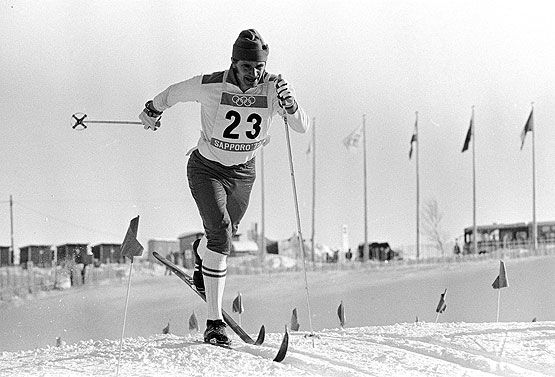
Yesterday a triple Olympic champion Eero Mäntyranta a Finnish cross-country skier passed away. His career spanned four Winter Olympics from 1960 in Squaw Valley to 1972 in Sapporo. In total he won seven Olympic medals.
In those 1960 Games he was part of the Finland team that took gold in the 4x10km relay. Four years later in Innsbruck he took double individual gold in the 15km and 30km.
He other Olympic performances were a silver in the 4x10km relay in 1964, silver in the 15km in Grenoble in 1968, plus bronzes in the 4x10km and 30km. In 1960 he had also been 6th in the 15km, 9th then 15th in the 50km in 1964 and 1968 and 19th in the 30km in 1972.
He also won the world championships at 30km twice along with three other medals. But his life is also a microcosm of sports, genetics and drugs.
In 1972 he had tested positive for doping at his national championships but this was hushed up and only came to light after the Olympics. He had denied the doping allegations but admitted to taking hormones, which at the time of his competing were not prohibited.
But in the year that Lance Armstrong came clean about his doping the story of Mäntyranta is also a medical one. Twenty three years ago a scientific paper noted that "a 53-year-old male, whose Hb (haemoglobin) level has been 200 g/litre or greater since childhood (last measurement, 236 g/litre), has been one of the best cross-country skiers in the world, having won three Olympic gold medals and two world championships." The average for an adult male is 140-180g/L.
That subject was Mäntyranta and indeed samples for other members of his family showed that about 50% of them had the same high levels of haemoglobin. It was discovered that he and some of his family had primary familial and congenital polycythemia due to a mutation in the erythropoietin receptor gene. Quite a nice mutation for an endurance athlete to have as it can result in up to 50% more oxygen being carried by the blood to the muscles. His1964 performance saw him win by over 15 seconds the largest gap in the "sprint" distance in Winter Olympic history, the next five were all within 20 seconds following a normal distribution of performance.
The 76 year old former champion was a medical phenomena, which aided his sporting achievements. Although he later admitted to taking what is now a performance enhancer it wasn't during his time of competing a banned substance, but he didn't really need it for an advantage over his competitors as that was built into his family DNA.
Eero Antero Mäntyranta Olympic Champion Cross-Country Skier 20 Nov 1937 - 30 Dec 2013
Yesterday a triple Olympic champion Eero Mäntyranta a Finnish cross-country skier passed away. His career spanned four Winter Olympics from 1960 in Squaw Valley to 1972 in Sapporo. In total he won seven Olympic medals.
In those 1960 Games he was part of the Finland team that took gold in the 4x10km relay. Four years later in Innsbruck he took double individual gold in the 15km and 30km.
He other Olympic performances were a silver in the 4x10km relay in 1964, silver in the 15km in Grenoble in 1968, plus bronzes in the 4x10km and 30km. In 1960 he had also been 6th in the 15km, 9th then 15th in the 50km in 1964 and 1968 and 19th in the 30km in 1972.
He also won the world championships at 30km twice along with three other medals. But his life is also a microcosm of sports, genetics and drugs.
In 1972 he had tested positive for doping at his national championships but this was hushed up and only came to light after the Olympics. He had denied the doping allegations but admitted to taking hormones, which at the time of his competing were not prohibited.
But in the year that Lance Armstrong came clean about his doping the story of Mäntyranta is also a medical one. Twenty three years ago a scientific paper noted that "a 53-year-old male, whose Hb (haemoglobin) level has been 200 g/litre or greater since childhood (last measurement, 236 g/litre), has been one of the best cross-country skiers in the world, having won three Olympic gold medals and two world championships." The average for an adult male is 140-180g/L.
That subject was Mäntyranta and indeed samples for other members of his family showed that about 50% of them had the same high levels of haemoglobin. It was discovered that he and some of his family had primary familial and congenital polycythemia due to a mutation in the erythropoietin receptor gene. Quite a nice mutation for an endurance athlete to have as it can result in up to 50% more oxygen being carried by the blood to the muscles. His1964 performance saw him win by over 15 seconds the largest gap in the "sprint" distance in Winter Olympic history, the next five were all within 20 seconds following a normal distribution of performance.
The 76 year old former champion was a medical phenomena, which aided his sporting achievements. Although he later admitted to taking what is now a performance enhancer it wasn't during his time of competing a banned substance, but he didn't really need it for an advantage over his competitors as that was built into his family DNA.
Eero Antero Mäntyranta Olympic Champion Cross-Country Skier 20 Nov 1937 - 30 Dec 2013
New Year's Resolution for my sporting almanac
This blog was initially set up to cover minority sports and sports that are not normally covered in the media. Some of that is also women's participation in some sports that the print and television media obsess only about their male counterparts.
Even reading the Guardian this year has at times been a pain as stories that I know inside out are exciting and thrilling are confined to just a paragraph in the anything else section, hidden away between the football, rugby, cricket and racing (the majority of that only the male versions).
My aim for 2014 is to produce at least one story a day on this blog. It will contain something of note. So bear with me and follow.
Even reading the Guardian this year has at times been a pain as stories that I know inside out are exciting and thrilling are confined to just a paragraph in the anything else section, hidden away between the football, rugby, cricket and racing (the majority of that only the male versions).
My aim for 2014 is to produce at least one story a day on this blog. It will contain something of note. So bear with me and follow.
28 December 2013
The Good, the Bad and the Ugly of sport in 2013
I'm going to try and sum up the year in sport in three overriding categories
The Good
There are many contenders for the good. England's win of the Ashes of the summer, sadly that is wiped out by their loss of them again this winter. Chris Froome winning the Tour de France in his own right, he won it with more style of his own on the bike than Sir Bradley Wiggins but with less charisma. But after years of me queuing, sometimes with the next British hope on court that day I think it has to go to Andy Murray and lifting the Wimbledon gents singles trophy.
The Bad
I could start with the way England gave up the Ashes this winter. Or maybe the weather during most of this year's Giro d'Italia, it seemed to affect anyone who took part in it for a couple of months. However, I have gone for the multiple delaminations of Pirelli's tyres that occurred throughout the season, which came to a head at the British Grand Prix in July.
The Ugly
There can only be one contender for the ugly and it happened way back in January. It came after years of denial and ended up in a series of simply yeses to questions put by Oprah Winfrey to Lance Armstrong.
The Good
There are many contenders for the good. England's win of the Ashes of the summer, sadly that is wiped out by their loss of them again this winter. Chris Froome winning the Tour de France in his own right, he won it with more style of his own on the bike than Sir Bradley Wiggins but with less charisma. But after years of me queuing, sometimes with the next British hope on court that day I think it has to go to Andy Murray and lifting the Wimbledon gents singles trophy.
The Bad
I could start with the way England gave up the Ashes this winter. Or maybe the weather during most of this year's Giro d'Italia, it seemed to affect anyone who took part in it for a couple of months. However, I have gone for the multiple delaminations of Pirelli's tyres that occurred throughout the season, which came to a head at the British Grand Prix in July.
The Ugly
There can only be one contender for the ugly and it happened way back in January. It came after years of denial and ended up in a series of simply yeses to questions put by Oprah Winfrey to Lance Armstrong.
23 October 2013
Le 101eme Tour de France Parcours #TDF2014
There are 255 days until the 101st edition of the Tour de France. As we already knew it spends the first two day winding its way around Yorkshire, then on the third day travels from Cambridge to London, but today the remainder of the route was announced. Five of the nine new stage start/finish towns are in the UK Leeds, Harrogate, York, Sheffield and Cambridge.
It will go clockwise around France this year meaning that the Alps will come before the Pyrenees. But before the first rest day they will already have been in a French mountain range as stage ten returns to La Planche de Belle Filles a key stage to both the last two Tour winners. It was here in the Vosges mountains that Bradley Wiggins gained the yellow jersey in 2012 never to give it up and Chris Froome won his first stage in the Tour.
![]() |
| The Arenberg Trench |
Ypres is the first of the new French stage towns. The next will feature on the stage after the first rest day as the tour travels from Besançon to the rugby mad town of Oyannax in the Jura mountains.
![]() |
| Froome and Porte climb to Risoul in 2013 Critérium |
Col du Lautaret making its 41st Tour appearance since 1947 and Col d'Izoard making another of its frequent appearances. Who will add their name to amongst others Fausto Coppi, Louison Bobbet and Eddy Merckx, it will be a lesser name as I expect there will still be a breakaway ahead of the GC contenders at this point of the race.
The Pyrenees, however, should be where this race is decided and they start on stage 16. The Portet d'Aspet and Col de Ares act as appetisers before the infamous Port de Bailes and the long 21.5km descent into the Bagnères-de-Luchon finish. Next day sees the Col du Portillon, Col de Peyresourde and Col de Val Louron-Azet before climbing to the Pla d'Adet making its first appearance since 2005. However, Petresourde and Val Louron-Azet featured in the stage that after Froome gained the yellow jersey last year he found himself having to chase down moves himself without protection. He will be hoping not to find himself in the same sort of position again this year if he is in the Maillot Jaune.
![]() |
| Hautacam in 2000 |
The only time trial stage comes on the penultimate day from Bergerac to Périgueux. It is relatively long at 54km that is a time trial specialist has kept relatively close to the pure climbers could turn the race on its head. But this tour is most definitely designed for climbers. Even though there are only 6 mountain stages five of these are summit finishes.
7 October 2013
Giro d'Italia 2014 - Il Percorso
So today was the most excited I have ever been about the announcement of the route of 2014 Giro d'Italia. The fast that the 97th edition of the race will start here:
But also as well as spending three days in Ireland, which necessitate a start on Friday 9th May so that an extra 'rest'/transfer day to get the race back to Italy, there are some very interesting stages.
There is the Passo de Lupo, which only counts as a 10.6km climb despite having had to climb to the start of it on stage 9 to be a tough finish before the second rest day on the 18th May. But the race will only get harder from there on.
There are the 18.3km climb of Bielmonte, 11.8km of Oporo both on stage 14 which could well start to open up the race. The 18.6km climb to Plan di Montecampione on stage 15 just before the third and final rest day.
But after that rest day there will be 60km of climbing on stage 16 taking the Giro over the highest mountain pass in the Eastern Alp the Stelvio, but it is only the middle of the stage with Val Martello Martelltal still to come to complete the stage. Stage 18 will feature Passo di San Pellegrino (11.8 km) and finish on Panarotta (15.8 km). The next stage is a mountain time trial it is only 26.8km long but the last 19.3 of those are the climb of Monte Grappa.
If the Giro is still up for grabs on the last day the race might well be decided on Monte Zoncolan, and the stage called Welcome to Hell.
The tough climb has only appeared four times in the Giro making its debut in 2003 and appearing again in 2007 and being a summit finish in 2010 and again in 2011 (despite protests about a last minute route change). It has a long way to measure up to the history of the Stelvio (which appears in the middle of stage 17) but has already got a reputation for hardness that will continue to make it one to watch. It is only 101km long so not the longest, but the average gradient is 11.9% as the riders will climb 1203m. The maximum gradient is 22%.
It will certainly be a climbers Giro with the tough final week in the high mountains, but there is something for the sprinters. Mark Cavendish could well be targeting his first Grand Tour stage win on UK soil for stage 2 in Belfast, but Dublin on stage 3, Bari stage 4, Salsomaggiore Terme stage 10 (although a little lumpy in the run in), Rivarolo Canavese stage 13 and if they survive the mountains there is Vittorio Veneto stage 17 and the ride into the finish at Trieste. Along with the finish toFoligno on stage 7, which has a tough ramp near the end, but might still be available for the tougher sprinters, that gives 7 or 8 opportunities where the sprinters could shine. After his five stages wins from last year it will interesting to see what Mark Cavendish can do this time.
You can see a preview of the full percorso here:
![]() |
| Titanic Quarter, Belfast |
There is the Passo de Lupo, which only counts as a 10.6km climb despite having had to climb to the start of it on stage 9 to be a tough finish before the second rest day on the 18th May. But the race will only get harder from there on.
There are the 18.3km climb of Bielmonte, 11.8km of Oporo both on stage 14 which could well start to open up the race. The 18.6km climb to Plan di Montecampione on stage 15 just before the third and final rest day.
But after that rest day there will be 60km of climbing on stage 16 taking the Giro over the highest mountain pass in the Eastern Alp the Stelvio, but it is only the middle of the stage with Val Martello Martelltal still to come to complete the stage. Stage 18 will feature Passo di San Pellegrino (11.8 km) and finish on Panarotta (15.8 km). The next stage is a mountain time trial it is only 26.8km long but the last 19.3 of those are the climb of Monte Grappa.
If the Giro is still up for grabs on the last day the race might well be decided on Monte Zoncolan, and the stage called Welcome to Hell.
The tough climb has only appeared four times in the Giro making its debut in 2003 and appearing again in 2007 and being a summit finish in 2010 and again in 2011 (despite protests about a last minute route change). It has a long way to measure up to the history of the Stelvio (which appears in the middle of stage 17) but has already got a reputation for hardness that will continue to make it one to watch. It is only 101km long so not the longest, but the average gradient is 11.9% as the riders will climb 1203m. The maximum gradient is 22%.
It will certainly be a climbers Giro with the tough final week in the high mountains, but there is something for the sprinters. Mark Cavendish could well be targeting his first Grand Tour stage win on UK soil for stage 2 in Belfast, but Dublin on stage 3, Bari stage 4, Salsomaggiore Terme stage 10 (although a little lumpy in the run in), Rivarolo Canavese stage 13 and if they survive the mountains there is Vittorio Veneto stage 17 and the ride into the finish at Trieste. Along with the finish toFoligno on stage 7, which has a tough ramp near the end, but might still be available for the tougher sprinters, that gives 7 or 8 opportunities where the sprinters could shine. After his five stages wins from last year it will interesting to see what Mark Cavendish can do this time.
You can see a preview of the full percorso here:
Subscribe to:
Posts (Atom)